The New York Times · 15 January 1988
CP-1988-106
Israel’s Economy Is Suffering As Arab Workers Stay Home
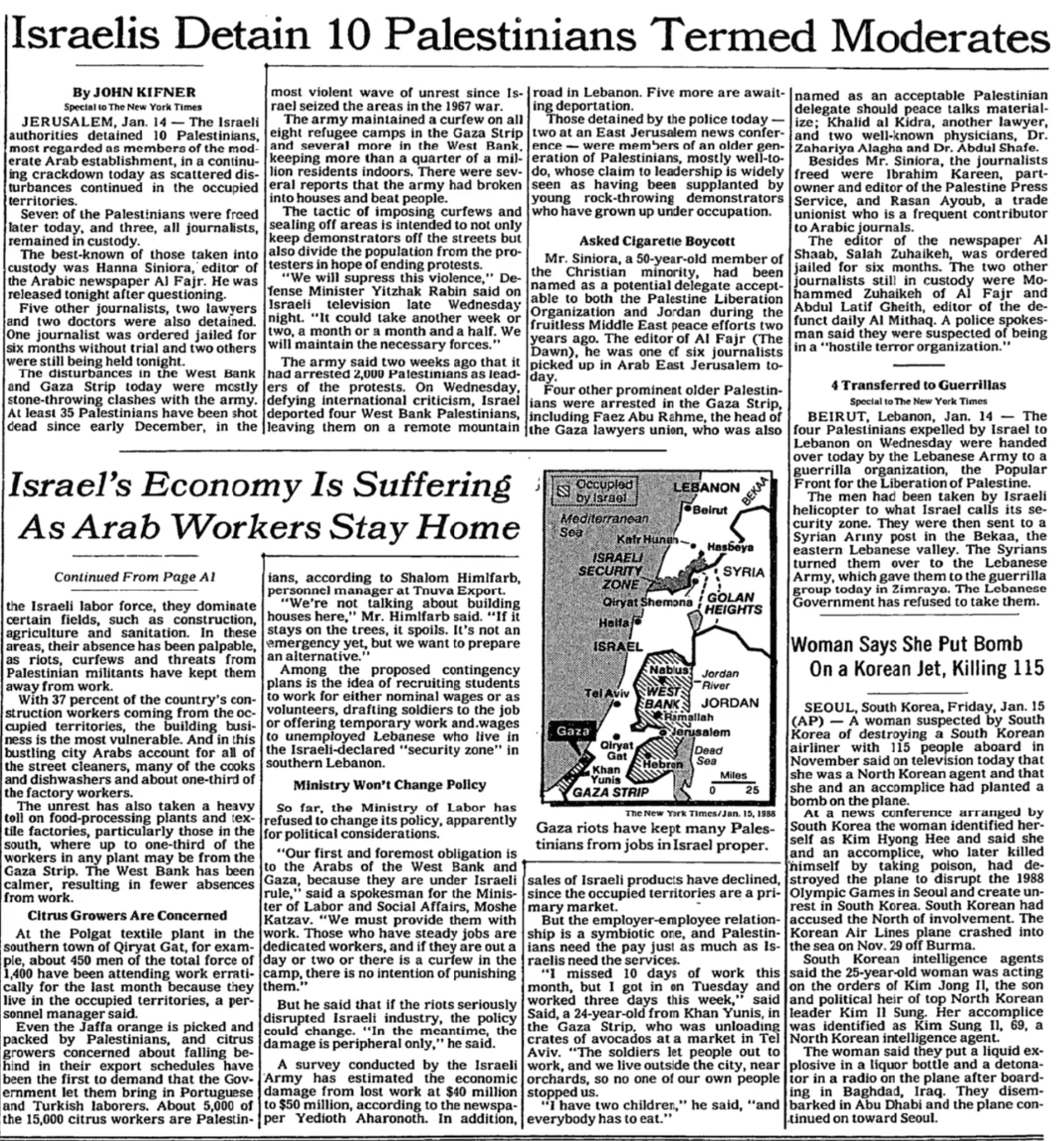
Transcribed from the clipping
the Israeli labor force, they dominate certain fields, such as construction, agriculture and sanitation. In these areas, their absence has been palpable, as riots, curfews and threats from Palestinian militants have kept them away from work.
With 37 percent of the country’s construction workers coming from the occupied territories, the building business is the most vulnerable. And in this bustling city Arabs account for all of the street cleaners, many of the cooks and dishwashers and about one-third of the factory workers.
The unrest has also taken a heavy toll on food-processing plants and textile factories, particularly those in the south, where up to one-third of the workers in any plant may be from the Gaza Strip. The West Bank has been calmer, resulting in fewer absences from work.
Citrus Growers Are Concerned At the Polgat textile plant in the southern town of Qiryat Gat, for example, about 450 men of the total force of 1,400 have been attending work erratically for the last month because they live in the occupied territories, a personnel manager said.
Even the Jaffa orange is picked and packed by Palestinians, and citrus growers concerned about falling behind in their export schedules have been the first to demand that the Government let them bring in Portuguese and Turkish laborers. About 5,000 of the 15,000 citrus workers are Palestinians, according to Shalom Himlfarb, personnel manager at Tnuva Export.
“We’re not talking about building houses here,” Mr. Himlfarb said. “If it stays on the trees, it spoils. It’s not an emergency yet, but we want to prepare an alternative.”
Among the proposed contingency plans is the idea of recruiting students to work for either nominal wages or as volunteers, drafting soldiers to the job or offering temporary work and.wages to unemployed Lebanese who live in the Israeli-declared “security zone” in southern Lebanon.
Ministry Won’t Change Policy So far, the Ministry of Labor has refused to change its policy, apparently for political considerations. “Our first and foremost obligation is to the Arabs of the West Bank and Gaza, because they are under Israeli rule,” said a spokesman for the Minister of Labor and Social Affairs, Moshe Katzav.
“We must provide them with work. Those who have steady jobs are dedicated workers, and if they are out a day or two or there is a curfew in the camp, there is no intention of punishing them.” But he said that if the riots seriously disrupted Israeli industry, the policy could change. “In the meantime, the damage is peripheral only,” he said.
A survey conducted by the Israeli Army has estimated the economic damage from lost work at $40 million to $50 million, according to the newspaper Yedioth Aharonoth. In addition, sales of Israeli products have declined, since the occupied territories are a primary market.
But the employer-employee relationship is a symbiotic one, and Palestinians need the pay just as much as Israelis need the services. “I missed 10 days of work this month, but I got in on Tuesday and worked three days this week,” said Said, a 24-year-old from Khan Yunis, in the Gaza Strip. who was unloading crates of avocados at a market in Tel Aviv.
“The soldiers let people out to work, and we live outside the city, near orchards, so no one of our own people stopped us. “I have two children,” he said, “and everybody has to eat.”
How this transcription was made
This scan is a complete newspaper page carrying TWO complete articles side by side, and the archive holds a record for each. This record transcribes the lower story, “Israel’s Economy Is Suffering As Arab Workers Stay Home”. The upper story on the same page, “Israelis Detain 10 Palestinians Termed Moderates” by John Kifner, is a separate record, o880115kifner. Both records show the whole page as it was printed rather than a crop of half of it, so the archive’s claim that every record is a photograph of the page its story ran on stays true; the cost is that the same photograph appears twice under two ids. The page also carries two shorter items not transcribed in either record: “4 Transferred to Guerrillas” from Beirut, and an Associated Press story from Seoul about the Korean Air bombing.
Cite this clipping
"Israel’s Economy Is Suffering As Arab Workers Stay Home," The New York Times, 15 January 1988. Covering Palestine archive, CP-1988-106. https://coveringpalestine.org/archive/cp-1988-106
More from The New York Times
- The Maine Colony in PalestineThe New York Times · 12 November 1866
- Jewish Colonization in PalestineThe New York Times · 9 December 1883
- Jewish State in Palestine OpposedThe New York Times · 9 July 1897
- ZIONIST CONGRESS IN BASELThe New York Times · 31 August 1897
- ROME FEARS THE ZIONISTSThe New York Times · 12 September 1897
- PROGRESS OF ZIONISMThe New York Times · 16 December 1901
- 852 more from this paper in the full text →
More from the 1980s
- Moderation Silenced by Israel RiotsThe Buffalo News · 3 January 1988
- Gaza Strip: the forgotten stepchildNorthwest Herald · 4 January 1988
- 'Iron Fist' Enslaves Gazans In Their LandThe Herald Sun · 6 January 1988
- Israel condemns U.N. vote on deportationsThe Birmingham News · 6 January 1988
- Israeli soldiers fire on protestersCarroll County Times · 6 January 1988
- Undaunted Palestinians resume violenceThe News & Observer · 6 January 1988
- All 527 clippings from the 1980s →
Last updated 2 November 2026
This record is part of Covering Palestine, an archive of American newspaper clippings about Palestinians, 1724 to 2023. Researched and assembled by Maria Robles.
The clipping belongs to the newspaper that printed it, or to the news agency that supplied the copy. It is reproduced here for research, criticism and commentary. A city here is where the newspaper was published, not where the story came from, and on most records it was taken from the masthead.
Something wrong here, or something you know about this clipping? The archive is still being built and corrections are wanted: maria@rozumstudio.com, quoting CP-1988-106.
Everything printed in 1988 · Printed on this day · See it in the archive reel · Full text of every clipping · Dataset