The New York Times · 3 April 1988
CP-1988-113
ARAB RAGE INSIDE ISRAEL
As violence builds in the occupied territories, Israeli Arabs embrace the Palestinians as ‘our people.’
By Ze’ev Chafets
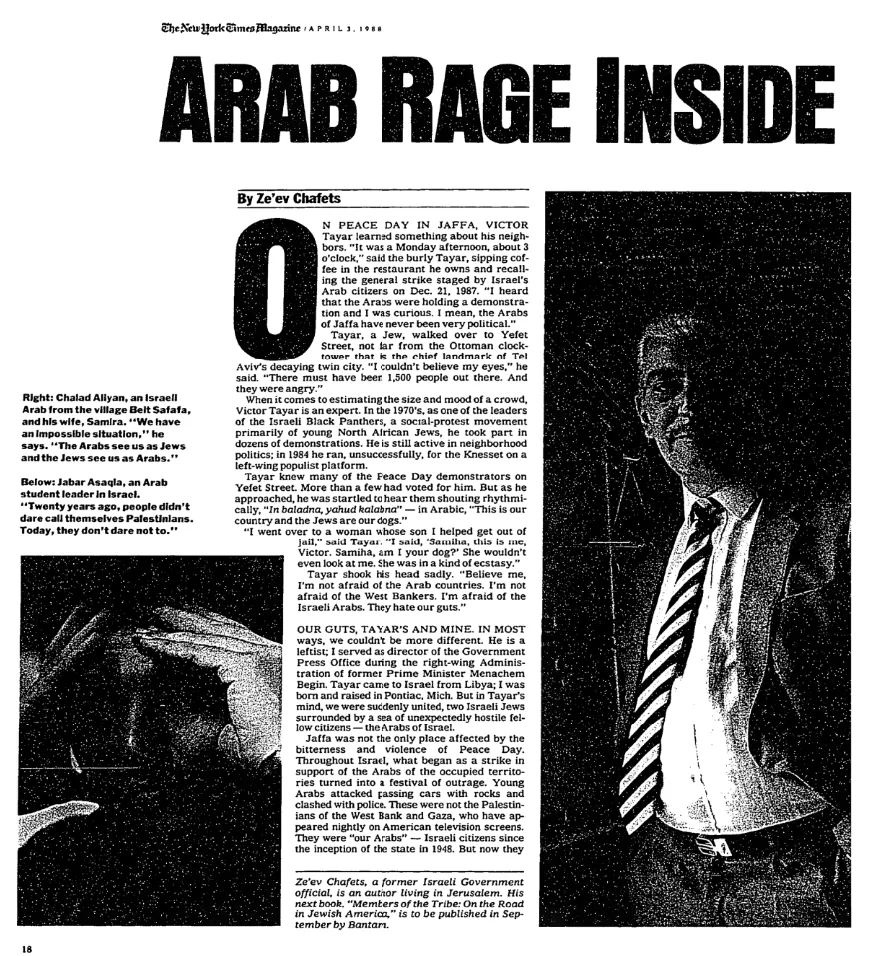
Transcribed from the clipping
ON PEACE DAY IN JAFFA, VICTOR Tayar learned something about his neighbors. “It was a Monday afternoon, about 3 o’clock,” said the burly Tayar, sipping coffee in the restaurant he owns and recalling the general strike staged by Israel’s Arab citizens on Dec. 21, 1987. “I heard that the Arabs were holding a demonstration and I was curious.
I mean, the Arabs of Jaffa have never been very political.” Tayar, a Jew, walked over to Yefet Street, not far from the Ottoman clocktower that is the chief landmark of Tel Aviv’s decaying twin city. “I couldn’t believe my eyes,” he said. “There must have been 1,500 people out there.
And they were angry.” … “We were always Arabs first, then Israelis,” said Anan Safadi, an anchorman on Israel’s Arabic television. “But since 1967, a third identity has begun to surface — Palestinian. That identity is still third for most of us, but it is growing.” NOWHERE IS THIS MORE APPARENT than in Beit Safafa, located on the southern outskirts of Jerusalem.
The minarets of the village’s mosques were visible from the living-room window of the house I lived in for many years. But I had never set foot in Beit Safafa, until this past February. … Following the war of independence, it was divided down the middle; half was ceded to Israel by Jordan.
A fence was built, guard posts were set up and the residents of the two sides were separated for 20 years. Those on the upper slope became Jordanians; their cousins down below were transformed into Israelis. “The fence ran along that road,” said Chalad Aliyan, a lifelong resident, pointing to an invisible line that he can see only too clearly.
“In those days we could only meet our relatives there on the most important festivals. It was a terrible situation.” … “What can I do?” he asked plaintively, in heavily accented Hebrew. “I have received some threats from people, but my store is across the line, and if I close, I will have problems from inside.” … ARAB RAGE Continued from Page 20 apparent irony.
“I will tell you the truth,” Aliyan continued. “We have an impossible situation. The Arabs see us as Jews and the Jews see us as Arabs. Sometimes even our relatives on the other side of the village laugh at us and call us ‘Zionists.’
” Although Beit Safafa has been reunited for 20 years, significant differences remain between the residents of the two sides. The village has only one school, but two separate student bodies. Students from the Israeli side are taught an Israeli curriculum; those from the West Bank follow a Jordanian course of study.
Students on different sides of the school are taught different versions of the same subjects and events. Recently, for example, the Palestine National Covenant — the charter of the Palestine Liberation Organization — has been introduced as a subject in the Israeli Arab school system; but no mention is made of it in the Jordanian side of the school.
The “West Bankers” of Beit Safafa carry Jordanian passports and many of them work and travel in the Arab world. Aliyan’s brother-in-law Abdulrachman was raised on the Jordanian side of Beit Safafa, and recently returned after several years in Kuwait.
Although he was 11 years old when the village was reunited, he still speaks only rudimentary Hebrew and is uneasy around Israelis. “If I go inside I feel afraid,” he said. “I try to stay on our side of the line.” “For me it is the opposite,” said Aliyan.
“I have an Israeli license plate on my car and I have been stoned in the West Bank. What am I supposed to do, drive around with a kaffiyeh on my head?” Despite the differences between the town’s Israeli and West Bank residents, there are growing signs of unity in Beit Safafa.
During a recent demonstration, six young men were arrested for clashing with the police; two of them were from the Israeli side. Abdulrachman considered this natural. “If we are all one people, then what happens on the outside should happen on the inside,” he said simply. Aliyan frowned but he didn’t contradict him. “But are you all one people?”
I asked. The mukhtar of Israeli Beit Safafa paused before he answered. “One people? Of course,” said Chalad Aliyan. “Abdulrachman is a Jordanian citizen and I am an Israeli citizen. But we are all Palestinians.”
TWENTY YEARS AGO, when Israeli leaders like Golda Meir still denied the existence of a Palestinian people, such a declaration would have been considered radical, even subversive. Today, most Arabs consider it a simple statement of fact.
Before 1967, the Israeli establishment tended to think of the nation’s Arab citizens as separate — and somehow different — from the rest of the Arab world. That changed when the Six Day War brought Israel’s Jews into contact with the more than one million Palestinians in the West Bank and Gaza.
“After 1967, most Israelis began to see us the same way they see the Palestinians in the territories, as aravim — Arabs,” said Anan Safadi, the journalist. Safadi also believes that the recent uprising in the territories has reinforced the Israeli Arabs’ self-image as Palestinians.
In the last Knesset elections, in 1984, the Arab vote was almost evenly divided between non-Zionist parties — the Communists and the P.L.O.-oriented Progressive List for Peace — and Zionist parties, primarily the Labor Party. The rise of Palestinian consciousness today is most clearly visible among the Labor Party Arabs.
Once considered Uncle Toms by other Arabs and by Jews, many of them now sound remarkably like the more radical activists of the anti-Zionist camp. “The day of the nice Arab in Israeli politics is over,” said Mohammed Watad, sitting in his Knesset office. Not so long ago, Watad himself was considered the very model of a nice Israeli Arab.
As a boy, he belonged to the Arab Pioneers, an offshoot of a left-wing Zionist movement. In 1971, he wrote a play, in Hebrew, entitled “Dukium” (“Coexistence”), that was produced by the Haifa Theater. Ten years later, he was elected to Israel’s parliament as a candidate of the dovish, socialist Mapam Party.
“I wanted to change things from the inside,” he said, in flawless Hebrew. Today, Watad, the advocate of coexistence, is an angry
How this transcription was made
Transcribed from scans of THREE printed pages across two slides, which together carry one article. THE SLIDE CARRIES NO LABEL; the date, the newspaper, the page numbers, the headline, the deck and the byline are all read off the pages themselves. The masthead line reads 'The New York Times Magazine / APRIL 3, 1988' and the folios print 18, 19 and 20. THE HEADLINE RUNS ACROSS THE GUTTER: 'ARAB RAGE INSIDE' is on page 18 and 'ISRAEL' on page 19, so neither page read alone gives the whole headline. The deck is the italic standfirst on page 19. Page 19 is almost entirely a full-bleed photograph, reproduced so dark on this scan that nothing in it can be made out, and it carries no caption. THE EXCERPT CONTAINS THREE ELISIONS, each marked with an ellipsis: the first block is the opening of page 18 and the rest are from page 20. The article is marked 'Continued on Page 26' and page 26 is NOT among these scans, so the piece is incomplete in this deck and its final sentence breaks off unfinished. The large italic line at the top of page 20 is a pull quote, not a deck. The author is a former director of the Israeli Government Press Office, as the contributor note at the foot of page 18 states. Read from crops magnified to between eleven and thirty times page scale. The other part of this article was added on 2 November 2026 from a second clipping (m008_2.png).
Cite this clipping
"ARAB RAGE INSIDE ISRAEL," The New York Times, 3 April 1988, p. 18. Covering Palestine archive, CP-1988-113. https://coveringpalestine.org/archive/cp-1988-113
More from The New York Times
- The Maine Colony in PalestineThe New York Times · 12 November 1866
- Jewish Colonization in PalestineThe New York Times · 9 December 1883
- Jewish State in Palestine OpposedThe New York Times · 9 July 1897
- ZIONIST CONGRESS IN BASELThe New York Times · 31 August 1897
- ROME FEARS THE ZIONISTSThe New York Times · 12 September 1897
- PROGRESS OF ZIONISMThe New York Times · 16 December 1901
- 852 more from this paper in the full text →
More from the 1980s
- Moderation Silenced by Israel RiotsThe Buffalo News · 3 January 1988
- Gaza Strip: the forgotten stepchildNorthwest Herald · 4 January 1988
- 'Iron Fist' Enslaves Gazans In Their LandThe Herald Sun · 6 January 1988
- Israel condemns U.N. vote on deportationsThe Birmingham News · 6 January 1988
- Israeli soldiers fire on protestersCarroll County Times · 6 January 1988
- Undaunted Palestinians resume violenceThe News & Observer · 6 January 1988
- All 527 clippings from the 1980s →
Last updated 2 November 2026
This record is part of Covering Palestine, an archive of American newspaper clippings about Palestinians, 1724 to 2023. Researched and assembled by Maria Robles.
The clipping belongs to the newspaper that printed it, or to the news agency that supplied the copy. It is reproduced here for research, criticism and commentary. A city here is where the newspaper was published, not where the story came from, and on most records it was taken from the masthead.
Something wrong here, or something you know about this clipping? The archive is still being built and corrections are wanted: maria@rozumstudio.com, quoting CP-1988-113.
Everything printed in 1988 · Printed on this day · See it in the archive reel · Full text of every clipping · Dataset