The New York Times · 5 June 1988
CP-1988-131
Israeli Censorship Takes On Two Meanings
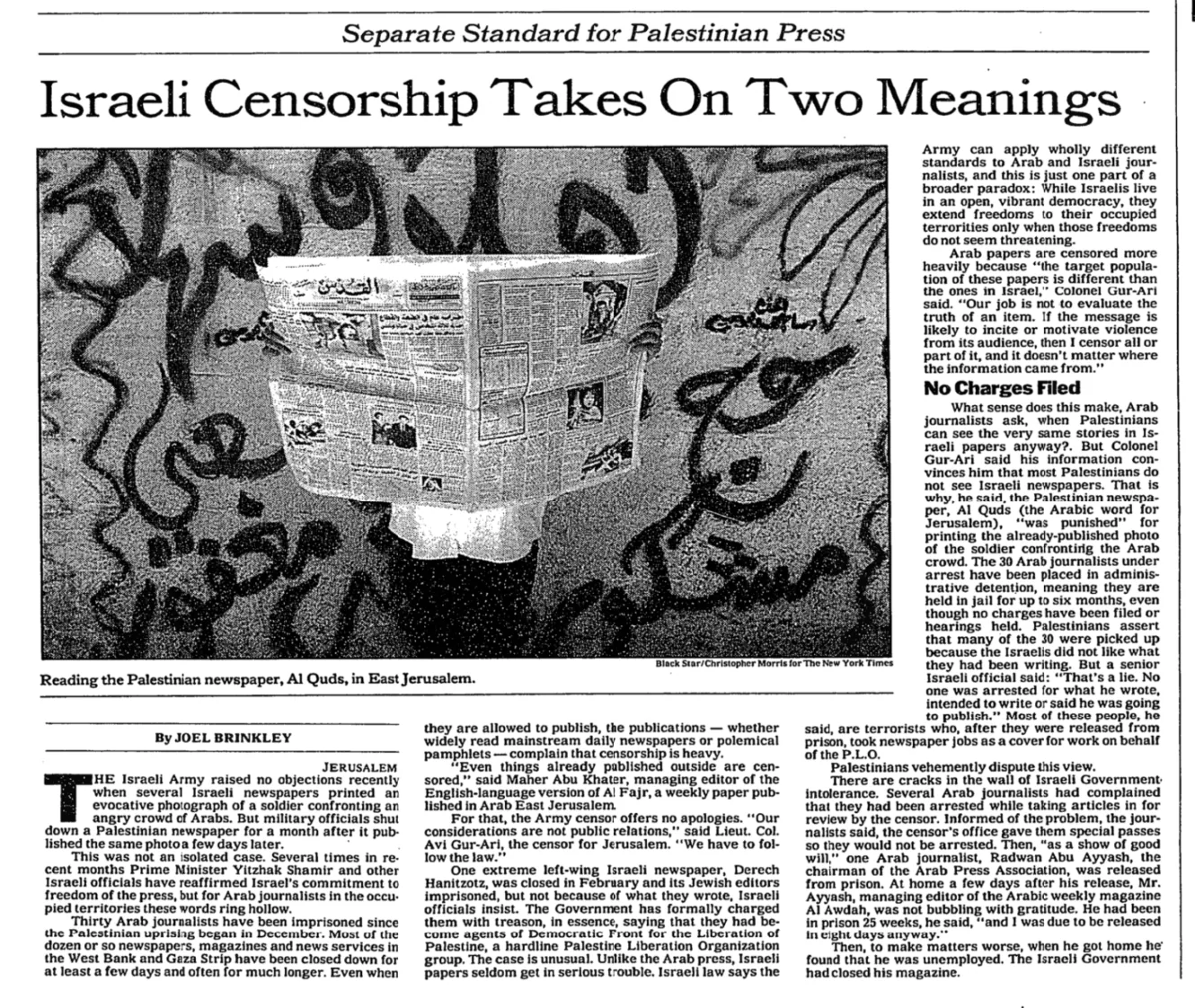
Transcribed from the clipping
JERUSALEM — THE Israeli Army raised no objections recently when several Israeli newspapers printed an evocative photograph of a soldier confronting an angry crowd of Arabs. But military officials shut down a Palestinian newspaper for a month after it published the same photo a few days later. This was not an isolated case.
Several times in recent months Prime Minister Yitzhak Shamir and other Israeli officials have reaffirmed Israel's commitment to freedom of the press, but for Arab journalists in the occupied territories these words ring hollow. Thirty Arab journalists have been imprisoned since the Palestinian uprising began in December.
Most of the dozen or so newspapers, magazines and news services in the West Bank and Gaza Strip have been closed down for at least a few days and often for much longer. Even when they are allowed to publish, the publications — whether widely read mainstream daily newspapers or polemical pamphlets — complain that censorship is heavy.
“Even things already published outside are censored,” said Maher Abu Khater, managing editor of the English-language version of Al Fajr, a weekly paper published in Arab East Jerusalem. For that, the Army censor offers no apologies. “Our considerations are not public relations,” said Lieut. Col. Avi Gur-Ari, the censor for Jerusalem. “We have to follow the law.”
One extreme left-wing Israeli newspaper, Derech Hanitzotz, was closed in February and its Jewish editors imprisoned, but not because of what they wrote, Israeli officials insist.
The Government has formally charged them with treason, in essence, saying that they had become agents of Democratic Front for the Liberation of Palestine, a hardline Palestine Liberation Organization group. The case is unusual. Unlike the Arab press, Israeli papers seldom get in serious trouble.
Israeli law says the Army can apply wholly different standards to Arab and Israeli journalists, and this is just one part of a broader paradox: While Israelis live in an open, vibrant democracy, they extend freedoms to their occupied terrorities only when those freedoms do not seem threatening.
How this transcription was made
No graphic physical detail on this page; nothing was compressed. Printed as set: "terrorities" for territories (upper-right column), "anyway?." with both marks (upper-right column), "agents of Democratic Front for the Liberation of Palestine" with no definite article (bottom-center column). All excerpt text was read from 4x and 5x magnified crops of the individual columns, not from the full-page view. — No masthead, no dateline rule, no page folio anywhere on the clipping. The date 1988-06-05 comes from Maria's label only. The page does carry internal evidence consistent with 1988: "Thirty Arab journalists have been imprisoned since the Palestinian uprising began in December" and "One extreme left-wing Israeli newspaper, Derech Hanitzotz, was closed in February" — the first intifada began December 1987 and Derech Hanitzotz was closed in February 1988. So the year is corroborated by the text; the day and month are not confirmed by anything on the page. — Reading order on the page is: bottom-left column, bottom-center column, then the tall column at upper right (which sits beside the photograph), then the bottom-right column. The excerpt follows that order and stops at the end of the paragraph that closes the upper-right column's first block. "terrorities" in the last sentence is as printed. — The italic line "Separate Standard for Palestinian Press", set between rules above the headline at the top of the page, is a kicker, not a deck. Per the deck rule it is left out of `dek` and recorded here.
Cite this clipping
"Israeli Censorship Takes On Two Meanings," The New York Times, 5 June 1988. Covering Palestine archive, CP-1988-131. https://coveringpalestine.org/archive/cp-1988-131
More from The New York Times
- The Maine Colony in PalestineThe New York Times · 12 November 1866
- Jewish Colonization in PalestineThe New York Times · 9 December 1883
- Jewish State in Palestine OpposedThe New York Times · 9 July 1897
- ZIONIST CONGRESS IN BASELThe New York Times · 31 August 1897
- ROME FEARS THE ZIONISTSThe New York Times · 12 September 1897
- PROGRESS OF ZIONISMThe New York Times · 16 December 1901
- 852 more from this paper in the full text →
More from the 1980s
- Moderation Silenced by Israel RiotsThe Buffalo News · 3 January 1988
- Gaza Strip: the forgotten stepchildNorthwest Herald · 4 January 1988
- 'Iron Fist' Enslaves Gazans In Their LandThe Herald Sun · 6 January 1988
- Israel condemns U.N. vote on deportationsThe Birmingham News · 6 January 1988
- Israeli soldiers fire on protestersCarroll County Times · 6 January 1988
- Undaunted Palestinians resume violenceThe News & Observer · 6 January 1988
- All 527 clippings from the 1980s →
Last updated 2 November 2026
This record is part of Covering Palestine, an archive of American newspaper clippings about Palestinians, 1724 to 2023. Researched and assembled by Maria Robles.
The clipping belongs to the newspaper that printed it, or to the news agency that supplied the copy. It is reproduced here for research, criticism and commentary. A city here is where the newspaper was published, not where the story came from, and on most records it was taken from the masthead.
Something wrong here, or something you know about this clipping? The archive is still being built and corrections are wanted: maria@rozumstudio.com, quoting CP-1988-131.
Everything printed in 1988 · Printed on this day · See it in the archive reel · Full text of every clipping · Dataset