The New York Times · 15 March 1989
CP-1989-033
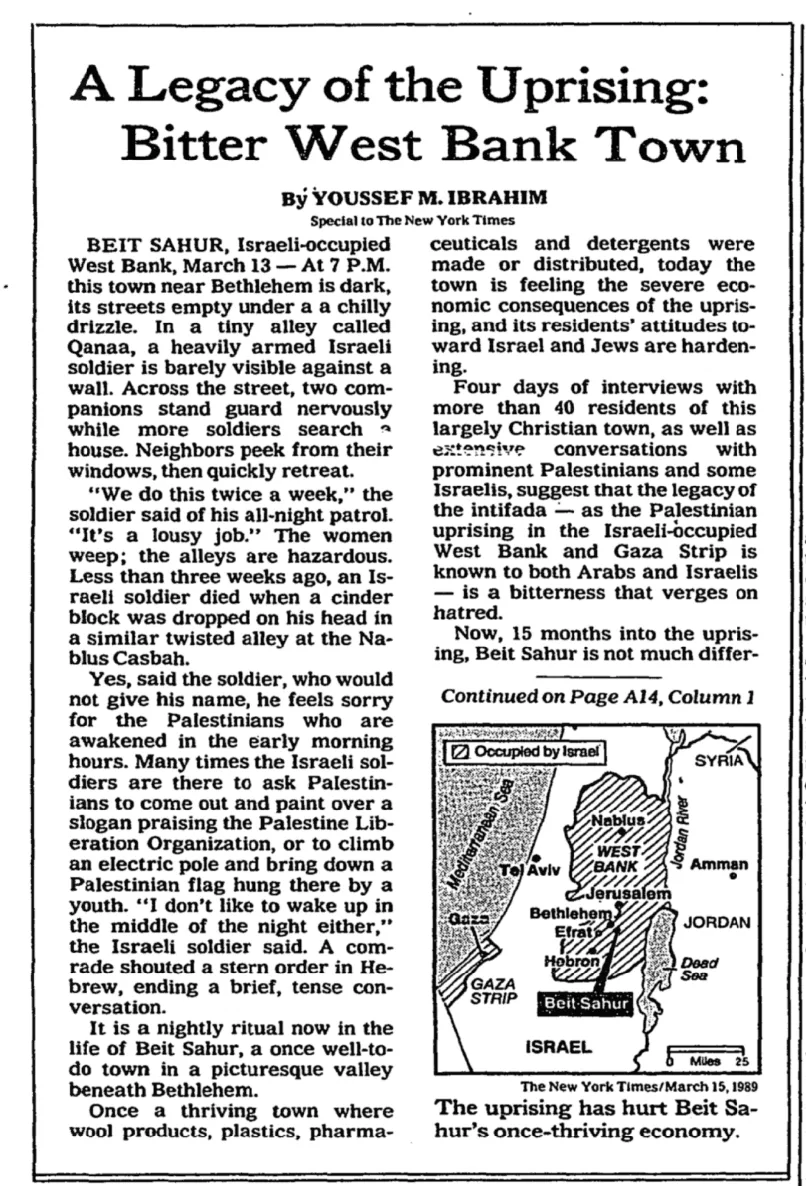
A Legacy of the Uprising: Bitter West Bank Town
Transcribed from the clipping
BEIT SAHUR, Israeli-occupied West Bank, March 13 — At 7 P.M. this town near Bethlehem is dark, its streets empty under a a chilly drizzle. In a tiny alley called Qanaa, a heavily armed Israeli soldier is barely visible against a wall. Across the street, two companions stand guard nervously while more soldiers search a house.
Neighbors peek from their windows, then quickly retreat. “We do this twice a week,” the soldier said of his all-night patrol. “It’s a lousy job.” The women weep; the alleys are hazardous. Less than three weeks ago, an Israeli soldier died when a cinder block was dropped on his head in a similar twisted alley at the Nablus Casbah.
Yes, said the soldier, who would not give his name, he feels sorry for the Palestinians who are awakened in the early morning hours. Many times the Israeli soldiers are there to ask Palestinians to come out and paint over a slogan praising the Palestine Liberation Organization, or to climb an electric pole and bring down a Palestinian flag hung there by a youth.
“I don’t like to wake up in the middle of the night either,” the Israeli soldier said. A comrade shouted a stern order in Hebrew, ending a brief, tense conversation. It is a nightly ritual now in the life of Beit Sahur, a once well-to-do town in a picturesque valley beneath Bethlehem.
Once a thriving town where wool products, plastics, pharmaceuticals and detergents were made or distributed, today the town is feeling the severe economic consequences of the uprising, and its residents’ attitudes toward Israel and Jews are hardening.
Four days of interviews with more than 40 residents of this largely Christian town, as well as extensive conversations with prominent Palestinians and some Israelis, suggest that the legacy of the intifada — as the Palestinian uprising in the Israeli-occupied West Bank and Gaza Strip is known to both Arabs and Israelis — is a bitterness that verges on hatred.
Cite this clipping
"A Legacy of the Uprising: Bitter West Bank Town," The New York Times, 15 March 1989. Covering Palestine archive, CP-1989-033. https://coveringpalestine.org/archive/cp-1989-033
More from The New York Times
- The Maine Colony in PalestineThe New York Times · 12 November 1866
- Jewish Colonization in PalestineThe New York Times · 9 December 1883
- Jewish State in Palestine OpposedThe New York Times · 9 July 1897
- ZIONIST CONGRESS IN BASELThe New York Times · 31 August 1897
- ROME FEARS THE ZIONISTSThe New York Times · 12 September 1897
- PROGRESS OF ZIONISMThe New York Times · 16 December 1901
- 852 more from this paper in the full text →
More from the 1980s
- ArafatThe Times · 18 January 1989
- Israeli officials play down offer from Shamir to withdraw troopsThe Miami Herald · 3 February 1989
- Shamir offer not newWorcester Telegram · 3 February 1989
- Israelis Study Devices In Blasts in West BankThe New York Times · 16 February 1989
- Can't rule, absorb, bar or expel PalestiniansSt. Louis Jewish Light · 3 March 1989
- THE AMBIGUOUS YASIR ARAFATThe New York Times · 12 March 1989
- All 527 clippings from the 1980s →
The same copy, in 1 other paper
Their text and this one are nearly identical. Found by comparing transcriptions, not by reading them side by side, so this establishes that the text overlaps and not that these papers ran the same dispatch. How this was done.
Last updated 2 November 2026
This record is part of Covering Palestine, an archive of American newspaper clippings about Palestinians, 1724 to 2023. Researched and assembled by Maria Robles.
The clipping belongs to the newspaper that printed it, or to the news agency that supplied the copy. It is reproduced here for research, criticism and commentary. A city here is where the newspaper was published, not where the story came from, and on most records it was taken from the masthead.
Something wrong here, or something you know about this clipping? The archive is still being built and corrections are wanted: maria@rozumstudio.com, quoting CP-1989-033.
Everything printed in 1989 · Printed on this day · See it in the archive reel · Full text of every clipping · Dataset