Courier-Journal · 19 March 1989
CP-1989-034
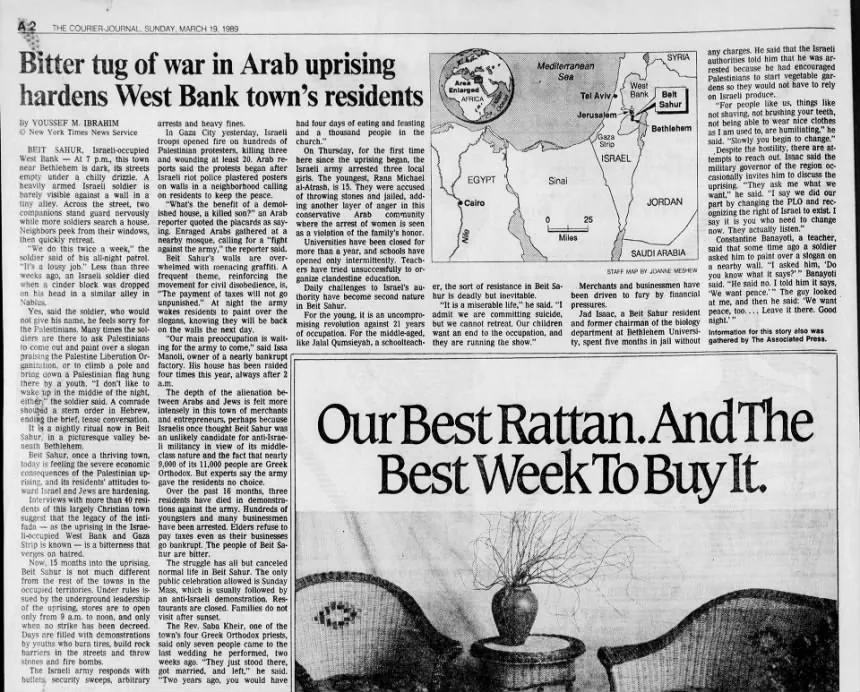
Bitter tug of war in Arab uprising hardens West Bank town’s residents
Transcribed from the clipping
BEIT SAHUR, Israeli-occupied West Bank — At 7 p.m., this town near Bethlehem is dark, its streets empty under a chilly drizzle. A heavily armed Israeli soldier is barely visible against a wall in a tiny alley. Across the street, two companions stand guard nervously while more soldiers search a house. Neighbors peek from their windows, then quickly retreat.
“We do this twice a week,” the soldier said of his all-night patrol. “It’s a lousy job.” The women weep; the alleys are hazardous. Less than three weeks ago, an Israeli soldier died when a cinder block was dropped on his head in a similar twisted alley at the Nablus Casbah.
Yes, said the soldier, who would not give his name, he feels sorry for the Palestinians who are awakened in the early morning hours. Many times the Israeli soldiers are there to ask Palestinians to come out and paint over a slogan praising the Palestine Liberation Organization, or to climb a pole and bring down a Palestinian flag hung there by a youth.
“I don’t like to wake up in the middle of the night either,” the soldier said. A comrade shouted a stern order in Hebrew, ending the brief, tense conversation. It is a nightly ritual now in Beit Sahur, in a picturesque valley beneath Bethlehem.
Beit Sahur, once a thriving town, today is feeling the severe economic consequences of the Palestinian uprising, and its residents’ attitudes toward Israel and Jews are hardening.
Interviews with more than 40 residents of this largely Christian town suggest that the legacy of the intifada — as the uprising in the Israeli-occupied West Bank and Gaza Strip is known — is a bitterness that verges on hatred. Now, 15 months into the uprising, Beit Sahur is not much different from the rest of the towns in the occupied territories.
Under rules issued by the underground leadership of the uprising, stores are to open only from 9 a.m. to noon, and only when no strike has been decreed. Days are filled with demonstrations by youths who burn tires, build rock barriers in the streets and throw stones and fire bombs. The Israeli army responds with bullets, security sweeps, arbitrary arrests and heavy fines.
In Gaza City yesterday, Israeli troops opened fire on hundreds of Palestinian protesters, killing three and wounding at least 20. Arab reports said the protests began after Israeli riot police plastered posters on walls in a neighborhood calling on residents to keep the peace.
“What’s the benefit of a demolished house, a killed son?” an Arab reporter quoted the placards as saying. Enraged Arabs gathered at a nearby mosque, calling for a “fight against the army,” the reporter said. Beit Sahur’s walls are overwhelmed with menacing graffiti.
A frequent theme, reinforcing the movement for civil disobedience, is, “The payment of taxes will not go unpunished.” At night the army wakes residents to paint over the slogans, knowing they will be back on the walls the next day. “Our main preoccupation is waiting for the army to come,” said Issa Manoli, owner of a nearly bankrupt factory.
His house has been raided four times this year, always after 2 a.m.
The depth of the alienation between Arabs and Jews is felt more intensely in this town of merchants and entrepreneurs, perhaps because Israelis once thought Beit Sahur was an unlikely candidate for anti-Israeli militancy in view of its middle-class nature and the fact that nearly 9,000 of its 11,000 people are Greek Orthodox.
But experts say the army gave the residents no choice. Over the past 16 months, three residents have died in demonstrations against the army. Hundreds of youngsters and many businessmen have been arrested. Elders refuse to pay taxes even as their businesses go bankrupt. The people of Beit Sahur are bitter. The struggle has all but canceled normal life in Beit Sahur.
The only public celebration allowed is Sunday Mass, which is usually followed by an anti-Israeli demonstration. Restaurants are closed. Families do not visit after sunset. The Rev. Saba Kheir, one of the town’s four Greek Orthodox priests, said only seven people came to the last wedding he performed, two weeks ago.
“They just stood there, got married, and left,” he said. “Two years ago, you would have had four days of eating and feasting and a thousand people in the church.” On Thursday, for the first time here since the uprising began, the Israeli army arrested three local girls. The youngest, Rana Michael al-Atrash, is 15.
They were accused of throwing stones and jailed, adding another layer of anger in this conservative Arab community where the arrest of women is seen as a violation of the family’s honor. Universities have been closed for more than a year, and schools have opened only intermittently. Teachers have tried unsuccessfully to organize clandestine education.
Daily challenges to Israel’s authority have become second nature in Beit Sahur. For the young, it is an uncompromising revolution against 21 years of occupation. For the middle-aged, like Jalal Qumsieyah, a schoolteacher, the sort of resistance in Beit Sahur is deadly but inevitable. “It is a miserable life,” he said.
“I admit we are committing suicide, but we cannot retreat. Our children want an end to the occupation, and they are running the show.” Merchants and businessmen have been driven to fury by financial pressures. Jad Isaac, a Beit Sahur resident and former chairman of the biology department at Bethlehem University, spent five months in jail without any charges.
He said that the Israeli authorities told him that he was arrested because he had encouraged Palestinians to start vegetable gardens so they would not have to rely on Israeli produce. “For people like us, things like not shaving, not brushing your teeth, not being able to wear nice clothes as I am used to, are humiliating,” he said.
“Slowly you begin to change.” Despite the hostility, there are attempts to reach out. Isaac said the military governor of the region occasionally invites him to discuss the uprising. “They ask me what we want,” he said. “I say we did our part by changing the PLO and recognizing the right of Israel to exist. I say it is you who need to change now.
They actually listen.” Constantine Banayoti, a teacher, said that some time ago a soldier asked him to paint over a slogan on a nearby wall. “I asked him, ‘Do you know what it says?’” Banayoti said. “He said no. I told him it says, ‘We want peace.’” The guy looked at me, and then he said: ‘We want peace, too. ...
Leave it there. Good night.’”
Cite this clipping
"Bitter tug of war in Arab uprising hardens West Bank town’s residents," Courier-Journal, 19 March 1989, p. A2. Covering Palestine archive, CP-1989-034. https://coveringpalestine.org/archive/cp-1989-034
More from Courier-Journal
- Young Turks Would Drive Jews From PalestineCourier-Journal · 14 May 1911
- Rebirth of Holy LandCourier-Journal · 20 November 1927
- Arabs Blame U.S., Iraq Envoy SaysCourier-Journal · 13 April 1948
- Even Ear Muffs Will Not Silence The Case of the Homeless ArabsCourier-Journal · 4 September 1949
- Readers’ Point of View: Three Discussions of Arab-Israeli DiscordCourier-Journal · 28 December 1953
- Calls Palestine Deal All WrongCourier-Journal · 5 January 1954
- 11 more from this paper in the full text →
More from the 1980s
- ArafatThe Times · 18 January 1989
- Israeli officials play down offer from Shamir to withdraw troopsThe Miami Herald · 3 February 1989
- Shamir offer not newWorcester Telegram · 3 February 1989
- Israelis Study Devices In Blasts in West BankThe New York Times · 16 February 1989
- Can't rule, absorb, bar or expel PalestiniansSt. Louis Jewish Light · 3 March 1989
- THE AMBIGUOUS YASIR ARAFATThe New York Times · 12 March 1989
- All 527 clippings from the 1980s →
The same copy, in 1 other paper
Their text and this one are nearly identical. Found by comparing transcriptions, not by reading them side by side, so this establishes that the text overlaps and not that these papers ran the same dispatch. How this was done.
Last updated 2 November 2026
This record is part of Covering Palestine, an archive of American newspaper clippings about Palestinians, 1724 to 2023. Researched and assembled by Maria Robles.
The clipping belongs to the newspaper that printed it, or to the news agency that supplied the copy. It is reproduced here for research, criticism and commentary. A city here is where the newspaper was published, not where the story came from, and on most records it was taken from the masthead.
Something wrong here, or something you know about this clipping? The archive is still being built and corrections are wanted: maria@rozumstudio.com, quoting CP-1989-034.
Everything printed in 1989 · Printed on this day · See it in the archive reel · Full text of every clipping · Dataset