The New York Times · 14 September 1993
CP-1993-040
Reflections on Accord: New Hopes, Old Fears
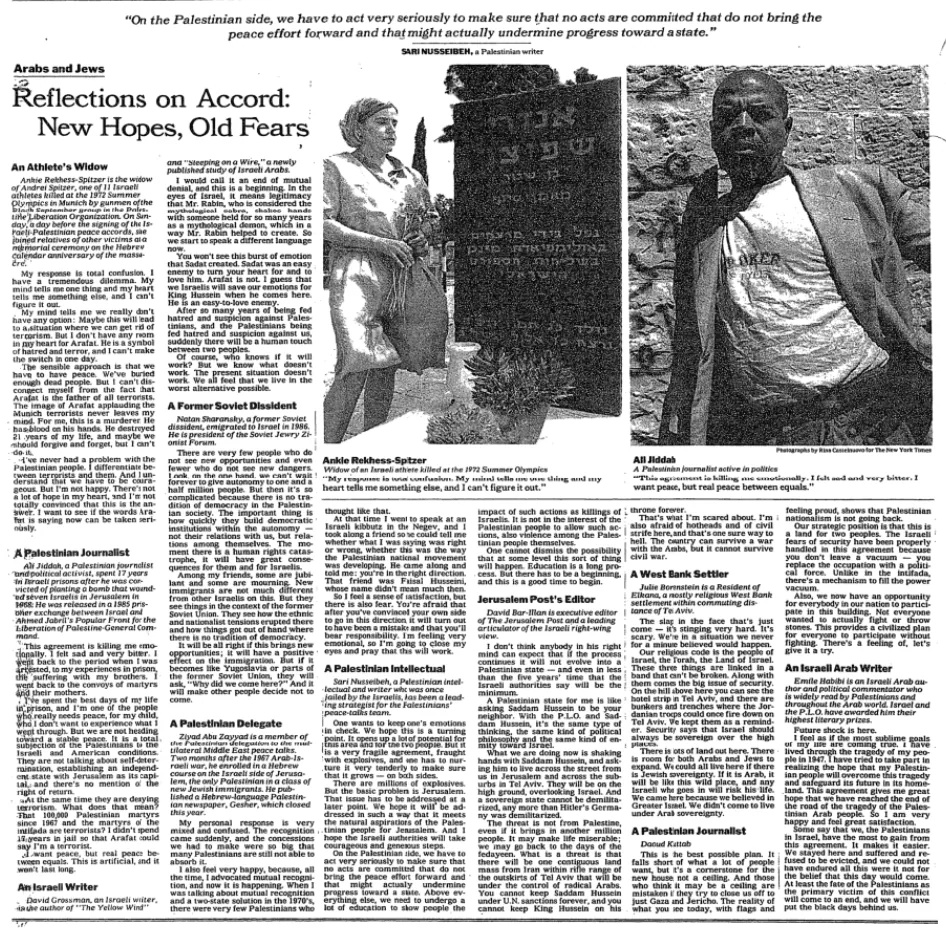
Transcribed from the clipping
An Athlete’s Widow Ankie Rekhess-Spitzer is the widow of Andrei Spitzer, one of 11 Israeli athletes killed at the 1972 Summer Olympics in Munich by gunmen of the Black September group in the Palestine Liberation Organization.
On Sunday, a day before the signing of the Israeli-Palestinian peace accords, she joined relatives of other victims at a memorial ceremony on the Hebrew calendar anniversary of the massacre. My response is total confusion. I have a tremendous dilemma. My mind tells me one thing and my heart tells me something else, and I can’t figure it out.
My mind tells me we really don’t have any option: Maybe this will lead to a situation where we can get rid of terrorism. But I don’t have any room in my heart for Arafat. He is a symbol of hatred and terror, and I can’t make the switch in one day. The sensible approach is that we have to have peace. We’ve buried enough dead people.
But I can’t disconnect myself from the fact that Arafat is the father of all terrorists. The image of Arafat applauding the Munich terrorists never leaves my mind. For me, this is a murderer He has blood on his hands. He destroyed 21 years of my life, and maybe we should forgive and forget, but I can’t do it.
I’ve never had a problem with the Palestinian people. I differentiate between terrorists and them. And I understand that we have to be courageous. But I’m not happy. There’s not a lot of hope in my heart, and I’m not totally convinced that this is the answer. I want to see if the words Arafat is saying now can be taken seriously.
A Palestinian Journalist Ali Jiddah, a Palestinian journalist and political activist, spent 17 years in Israeli prisons after he was convicted of planting a bomb that wounded seven Israelis in Jerusalem in 1968.
He was released in a 1985 prisoner exchange between Israel and Ahmed Jabril’s Popular Front for the Liberation of Palestine-General Command. This agreement is killing me emotionally. I felt sad and very bitter. I went back to the period when I was arrested, to my experiences in prison, the suffering with my brothers.
I went back to the convoys of martyrs and their mothers. I’ve spent the best days of my life in prison, and I’m one of the people who really needs peace, for my child, who I don’t want to experience what I went through. But we are not heading toward a stable peace. It is a total subjection of the Palestinians to the Israeli and American conditions.
They are not talking about self-determination, establishing an independent state with Jerusalem as its capital, and there’s no mention of the right of return. At the same time they are denying terrorism. What does that mean? That 100,000 Palestinian martyrs since 1967 and the martyrs of the intifada are terrorists?
I didn’t spend 17 years in jail so that Arafat could say I’m a terrorist. I want peace, but real peace between equals. This is artificial, and it won’t last long.
A Palestinian Intellectual Sari Nusseibeh, a Palestinian intellectual and writer who was once jailed by the Israelis, has been a leading strategist for the Palestinians’ peace-talks team. One wants to keep one’s emotions in check. We hope this is a turning point. It opens up a lot of potential for this area and for the two people.
But it is a very fragile agreement, fraught with explosives, and one has to nurture it very tenderly to make sure that it grows — on both sides. There are millions of explosives. But the basic problem is Jerusalem. That issue has to be addressed at a later point.
We hope it will be addressed in such a way that it meets the natural aspirations of the Palestinian people for Jerusalem. And I hope the Israeli authorities will take courageous and generous steps.
On the Palestinian side, we have to act very seriously to make sure that no acts are committed that do not bring the peace effort forward and that might actualy undermine progress toward a state. Above everything else, we need to undergo a lot of education to slow people the impact of such actions as killings of Israelis.
It is not in the interest of the Palestinian people to allow such actions, also violence among the Palestinian people themselves. One cannot dismiss the possibility that at some level this sort of thing will happen. Education is a long process. But there has to be a beginning, and this is a good time to begin.
A Palestinian Journalist Daoud Kuttab This is the best possible plan. It falls short of what a lot of people want, but it’s a cornerstone for the new house not a ceiling. And those who think it may be a ceiling are mistaken if they try to close us off to just Gaza and Jericho.
The reality of what you see today, with flags and feeling proud, shows that Palestinian nationalism is not going back. An Israeli Arab Writer Emile Habibi is an Israeli Arab author and political commentator who is widely read by Palestinians and throughout the Arab world. Israel and the P.L.O. have awarded him their highest literary prizes. Future shock is here.
I feel as if the most sublime goals of my life are coming true. I have lived through the tragedy of my people in 1947. I have tried to take part in realizing the hope that my Palestinian people will overcome this tragedy and safeguard its future in its homeland.
This agreement gives me great hope that we have reached the end of the road of the tragedy of the Palestinian Arab people. So I am very happy and feel great satisfaction. Some say that we, the Palestinians in Israel, have the most to gain from this agreement. It makes it easier.
We stayed here and suffered and refused to be evicted, and we could not have endured all this were it not for the belief that this day would come. At least the fate of the Palestinians as the primary victim of this conflict will come to an end, and we will have put the black days behind us.
Cite this clipping
"Reflections on Accord: New Hopes, Old Fears," The New York Times, 14 September 1993. Covering Palestine archive, CP-1993-040. https://coveringpalestine.org/archive/cp-1993-040
More from The New York Times
- The Maine Colony in PalestineThe New York Times · 12 November 1866
- Jewish Colonization in PalestineThe New York Times · 9 December 1883
- Jewish State in Palestine OpposedThe New York Times · 9 July 1897
- ZIONIST CONGRESS IN BASELThe New York Times · 31 August 1897
- ROME FEARS THE ZIONISTSThe New York Times · 12 September 1897
- PROGRESS OF ZIONISMThe New York Times · 16 December 1901
- 852 more from this paper in the full text →
More from the 1990s
- Women in waitingThe Grand Rapids Press · 7 January 1993
- Status of Palestinian women is changing ever so slowlyThe Jonesboro Sun · 10 January 1993
- Careful sips of freedomThe Journal Times · 23 January 1993
- Situation of Palestinian women slowly changingDaily Chronicle · 24 January 1993
- Rabin defends plan to return PalestiniansThe Daily Press · 4 February 1993
- Israeli soldiers raid wedding partyThe Journal Star · 13 February 1993
- All 374 clippings from the 1990s →
Last updated 2 November 2026
This record is part of Covering Palestine, an archive of American newspaper clippings about Palestinians, 1724 to 2023. Researched and assembled by Maria Robles.
The clipping belongs to the newspaper that printed it, or to the news agency that supplied the copy. It is reproduced here for research, criticism and commentary. A city here is where the newspaper was published, not where the story came from, and on most records it was taken from the masthead.
Something wrong here, or something you know about this clipping? The archive is still being built and corrections are wanted: maria@rozumstudio.com, quoting CP-1993-040.
Everything printed in 1993 · Printed on this day · See it in the archive reel · Full text of every clipping · Dataset