The New York Times · 28 July 1968
CP-1968-018
Arabs of Israel: A People in Search of an Identity
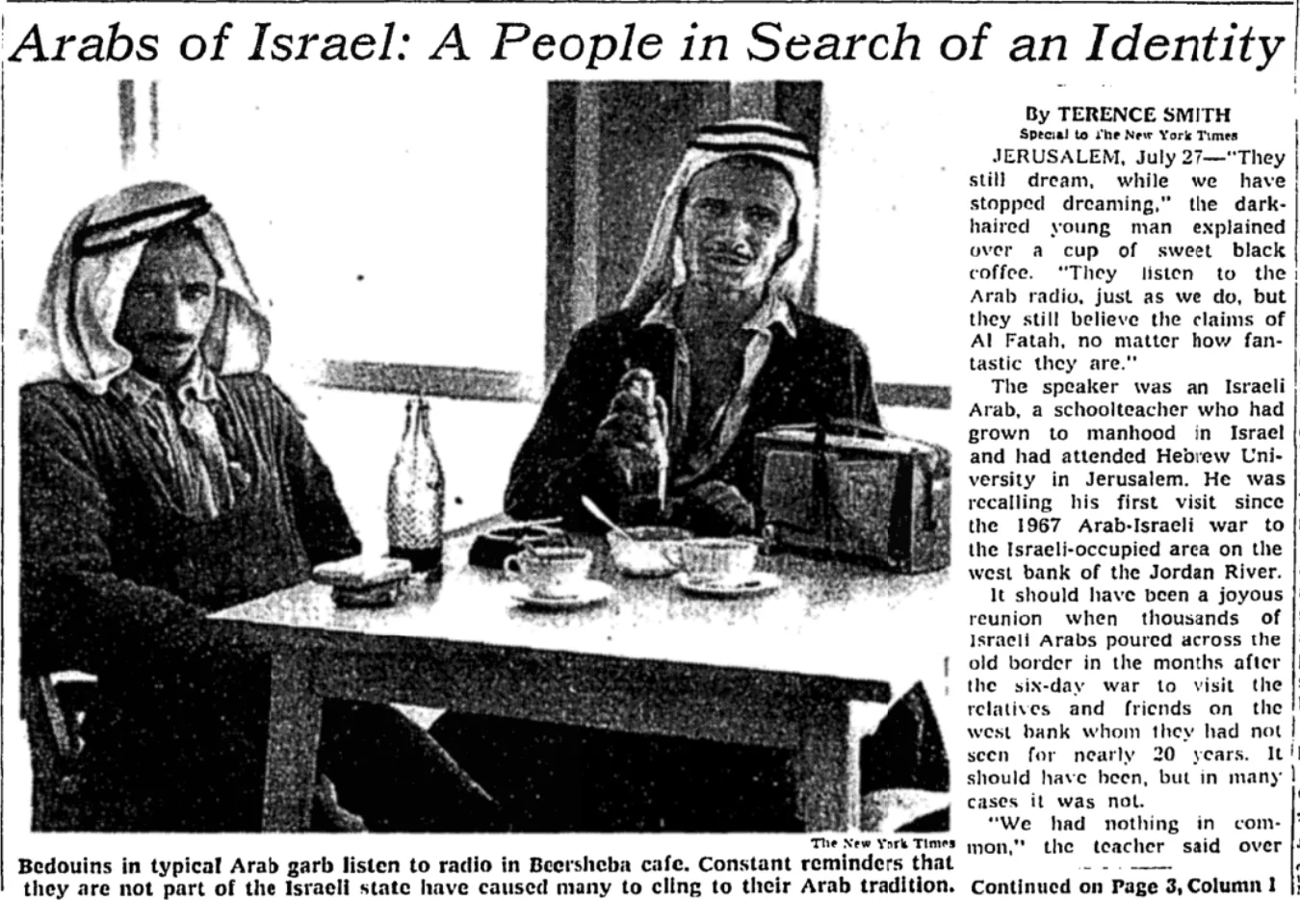
Transcribed from the clipping
JERUSALEM, July 27—“They still dream, while we have stopped dreaming,” the dark-haired young man explained over a cup of sweet black coffee. “They listen to the Arab radio, just as we do, but they still believe the claims of Al Fatah, no matter how fantastic they are.”
The speaker was an Israeli Arab, a schoolteacher who had grown to manhood in Israel and had attended Hebrew University in Jerusalem. He was recalling his first visit since the 1967 Arab-Israeli war to the Israeli-occupied area on the west bank of the Jordan River.
It should have been a joyous reunion when thousands of Israeli Arabs poured across the old border in the months after the six-day war to visit the relatives and friends on the west bank whom they had not seen for nearly 20 years. It should have been, but in many cases it was not.
“We had nothing in common,” the teacher said over … The 312,000 Arabs of Israel: A People in a Continuing Search for a Sense of Identity THEY FEEL APART FROM NEIGHBORS But Many Have Experienced Material Gains, If Not a Sense of Belonging Continued From Page 1, Col. 6 his coffee in a cafe in Jerusalem. “People I had known as a child were wary and suspicious of me.
They regarded me as an Israeli, not an Arab. Once, when I went into a shop in Bethlehem and asked the price of something in Arabic, the shopkeeper took one look at me and the clothes I was wearing, and answered me in Hebrew.”
The teacher’s experience has been shared by many of the 312,000 Israeli Arabs who have tried, in the wake of the war, to restore some of the ties they cherished before Palestine was partitioned in 1948.
For the Arabs who stayed behind in Israel, their inability to communicate with their former brothers on the west bank and in the Gaza Strip is yet another frustration in their continuing search for an identity.
Twenty years after they had elected to remain behind when more than a million of their brethren had fled to other countries, the Arabs of Israel are in as much of a quandary as ever. The majority of them are Moslems who think of themselves as Arabs, and members of the greater Arab Nation, but their sense of identity has been muddled by their surroundings.
They live in a country where the symbols and mode of life continually remind them that they are outsiders. Confusion Is Compounded The national flag bears the Star of David, the national anthem is Hatikvah and the avowed national goal is the “ingathering of the exiles.” Needless to say, the slogan refers to Jewish, not Arab, exiles.
Neither genuinely Arab nor genuinely Israeli, the personality of the Arabs of Israel has gradually split over two decades. Many of them speak Hebrew as fluently as Arabic, and their day of rest is Saturday, the Jewish Sabbath. Some have assimilated to the point of taking Jewish wives. It is estimated that 700 Arab men have married Jewish women.
However, there is only one recorded instance of a Jewish Israeli taking an Arab wife. All of these conflicting influences have left the Arabs of Israel confused about their own identity, and that confusion has been compounded by discoveriy in this last year of how little they they have in common with the Arabs of the west bank.
More often than not their reunions with their relatives and friends have served to remind them of their own isolation. “It made me wonder who we really are,” the teacher said. “We are certainly not Israelis, but we are a world apart from the people on the west bank.”
The continual exposure to the Jewish and Zionist elements of their adopted country has had a profound effect on the Arabs in Israel. Among the more educated, it has intensified their Arabness. The continual reminders that they are not part of the establishment of the state, that is, not Jews, have caused many to cling more stubbornly to their Arab tradition.
They maintain it in their dress, speech, literature and customs, and devote their energy to seeking equality as a protected minority. There are some, of course, who are avowed Arab nationalists, and their hatred for Israel is as fierce as any in the Arab world.
But this is an extreme group and though its members many devoutly wish for the elimnation of Israel as a state, few of them dare say so publicly and even fewer are prepared to do anything to bring it about. In this sense at least, the Arabs in Israel are loyal Israelis.
Attitude Is Ambivalent Their loyalty is partly motivated by a concern about how they would be treated by a conquering Arab army. And because of this, they had an ambivalent attitude toward the 1967 war.
“The war was a time of great personal conflict for the Arabs in Israel,” Abdul Aziz Zouabi, one of the Arab members of the Knesset, (Parliament), said in an interview. “We did not really want either side to lose.” Mr. Zouabi added: “We did not want to see our Arab brothers killed, but we did not want to se Israel overrun either.
After all, we live here and this is our country now, so we did not want Israel to lose. Also, we could not be sure how an Arab army would treat us.” An Arab student studying at Hebrew University in Jerusalem confirmed Mr. Zouabi’s view.
“We were afraid of both sides,” he said, “we knew that the Jordanians regarded us as Zionists and traitors, and we were worried about what the Israelis might do to us.” In fact, the Israeli authorities took only minimal security precautions.
In the two weeks before the war, only 52 Arabs were rounded up and detained, and during the six days of the fighting, only small units of border police were stationed in the Arab areas. There were no incidents of demonstrations of any kind in the Arab villages and towns in Israel during the war.
In the main, the Israeli Arabs stayed in their homes and listened to the radio, switching from the Israeli broadcasting service, to the Cairo radio, and back. Those who lived in and around Tel Aviv weer able to see for themselves that the Cairo radio reports of great fires in the city as a result of Arab bombs were fiction.
Some Arrested for Espionage In the period since the war, there have been a number of arrests of Israeli Arabs on espionage charges, but the total is small for the population. Twenty-four Arabs have been convicted of aiding guerrilla activities in the west-bank and Gaza areas.
An Israeli Army source concerned with the matter describes the security problem among Israeli Arabs as negligible. The real or imagined problem of security among the Arabs in Israel has been the stated reason for nearly all the restrictive measures that the authorities have applied against them over the 20 years of Israel’s existence.
When the war of independence was over in 1948, 170,000 Arabs of a prewar population of 1.3 million remained inside Israel. Those who left included most of the wealthy and the intelligentsia. Those who stayed behind were mostly uneducated peasants and laborers. They lived in villages and towns around Haifa, in the area near the Sea of Galilee and along the Jordanian border.
The city of Nazareth, for instance, was — and is — overwhelmingly Arab. Other Israeli areas with sizable Arab populations include: the Afula-Petah Tiqva region, Jaffa and Lydda. In 1949, military governments were established in the Arab districts and special defense and security zones were created.
Israeli Arabs were forbidden to travel into or out of these areas without a pass from the military commander. Military courts were established in the Arab districts. All trials were summary and could be held in closed session.
Restrictions Are Imposed With the consent of the Minister of Defense, the military commanders in the Arab areas could limit individual movements, impose restrictions on employment and business, issue deportation orders, search and seize at will, and detain a person up to one year if it was deemed necessary to maintain security.
Ironically, these regulations were originally set up by the British mandate authorities in Palestine to curb Jewish terrorism. The Israeli Government has never removed them from the books. Despite occasional protests in the Knesset from Arab members and liberal Israelis, the military government continued to administer the Arab areas until 1965.
The restrictions on travel were continued until last year, when they were lifted for all areas except the city of Elath, on the Gulf of Aqaba, which Israeli Arabs may still only visit by permit. The majority of Israeli Arabs describe themselves as second-class citizens.
In addtion to the military governments and travel restrictions, they cite as discriminatory the laws regarding expropriation of land and citizenship. Under the provisions of the so-called Law of the Return, any Jew coming to Israel may claim immediate citizenship simply by declaring his intention to settle. Non-Jews must undergo a waiting period.
The land-acquisition law, passed soon after the 1948 war, specified that the land of any person who fled his village and was absent when the Israeli forces entered the area would automatically be turned over to the custodian of absentee property. This applied even in cases where the landowners merely went elsewhere in Israel during the fighting.
When they returned to their homes they found their property taken over by the custodian. All told, about 1.6 million acres of Arab land was taken under this law, according to figures compiled by United Nations investigators.
An additional 120,000 acres of Arab land sequently turned over for Jewernment over the next 15 years, ostensibly for “security reasons and public purposes.” Criticized by Israeli Liberals Most of this land was subsequently turned over for Jewish settlement. Of 370 new Jewish settlements established between 1948 and 1953, 350 are on former Arab property.
In the case of the expropriated land, the Government is bound by law to pay compensation either in kind or cash. Of 15,000 claims for compensation, 11,400 have been settled so far. “The compensation is never adequate,” said one Israeli Arab whose family lost substantial property in the Jerusalem area.
“They offer you a fraction of what the land is worth, and you take that, or you get nothing.” The severity of this land policy has frequently been criticized by liberal Israelis, inside the Government and out, but the criticism generally has come after the fact.
Although the rights of the Arab minority are guaranteed by law in Israel, the Government has never made any serious effort to fully integrate them into the state. There are no Arab ministers in the Cabinet and no senior Arab civil servants.
The adviser on Arab affairs to the Premier is a Jew, as is his deputy, and the head of the Arab section in the Histadrut, the giant labor federation. There are seven Arab members of the Knesset, of a total 120 members. The Arabs of Israel do not serve in the army, but they and the Government agree that this situation is desirable.
“If it came to a war, we would have to fight Arabs.” Mr. Zouabi said, “We cannot very well be expected to kill our brothers and cousins.” In terms of army service and asecurity precautions, Israel makes a distinction between Arabs and the 32,000 Druze who live in the state.
The Druze are members of a sect that split off from traditional Islam in the 11th Century. Though they speak Arabic and live among the Arabs, they have proved themselves loyal fighters in Israel’s wars against the Arab countries.
There are special Druse units in the Israeli armed forces and Druse make up a significant part of the manpower of the paramilitary Israeli border police. The travel restrictions did not apply to them. Social Conditions Better On the positive side, the Arabs of Israel live in infinitely better social conditions now than they did 20 years ago.
New roads and housing have been constructed and there are now 353 Arab schools in Israel while in 1948 there were 56. The number of Arab pupils has risen from 11,129 in 1948 to 77,000. According to Government figures, the average yearly income of an Arab family in Nazareth is $2,000, while that of the average Jewish family is $2,100.
The figures are misleading, however, because there are usually several more working members in an Arab family. In addition, virtually no Arabs attain the $3,800-per-year average income earned by Jews in the professions in Israel. With the exception of teaching, the professions are largely closed to Israeli Arabs.
Many Israeli Arabs were inclined to discount these improvements over the years since they continually heard reports from the Amman and Cairo radios contending that the same progress was being made in the Arab countries. It was only after the 1967 war, when they visited the west-bank area that they discovered that the reports were untrue.
“I got quite a shock when I saw the way they were living.” Omar Masalha, an Israeli Arab psychology student at Hebrew University said. “Very little had changed, they were just as primitive as ever. Materially, we are much better off. Despite this advantage, Mr. Masalha is sharply critical of the Israeli Government’s treatment of the Arab minority.
“I always feel like a stranger—an outsider—here in my own land. The Government makes me feel as though I own nothing and can make no claim to anything in the state.” Mr. Masalha is one of 300 Israeli Arab students studying at Hebrew University.
He is also one of 20 who have recently received orders from the Government directing them not to travel in the occupied territories or in the former Jordanian sector of Jerusalem. “I got this order because the Government thinks I am critical of the state,” he said. “They did not really know what I think, but that does not matter.
If they decide you are against them, they restrict you.” More than anything else, Mr. Masalha is offended by the attitude he believes most Israelis harbor toward the Arab people. “They think we are all stupid and primitive and lazy, and it comes through in their attitude towards us, he said.
“I hear them talking in Hebrew about Arabs in the cafes attitude towards us,” he said. “I don’t like what they say, but I don’t speak up because here in Israel, they are strong and I am weak.” [PHOTOGRAPH, top centre of the page, with credit and caption:] The New York Times HEBREW UNIVERSITY in Jerusalem has 300 Israeli Arab students.
These are some. [MAP, top of the page right of the photograph, showing Lebanon, Syria, Haifa, Nazareth, Tel Aviv, Jerusalem, Beersheba, the NEGEV, ISRAEL and JORDAN, keyed to Arab population centres. Credit line beneath: “The New York Times” and “July 28, 1968”.
The key is too small to read reliably at this scan resolution and I have not transcribed it.] [The remainder of the page, right-hand side and foot, is display advertising — Tiffany & Co., Miss Bergdorf, “Tailored Woman” — and is not part of the article.]
How this transcription was made
Read from the scan at 2x to 7x by a machine looking at the image of the page, not by OCR and not by a person. No masthead or folio; the date rests on the dateline 'JERUSALEM, July 27' plus one day and on the slide label, which is the only source for the year. This is a page-one display block - headline, two-column photograph, a single column of type and a jump line - so the excerpt is short and ends mid-sentence above 'Continued on Page 3, Column 1'. The Israeli Arab schoolteacher who speaks three times in that column is given a profession, a university and a hair colour and never a name; the continuation on page 3 is a priority re-scan. The other part of this article was added on 2 November 2026 from a second clipping (m004_1.png).
Cite this clipping
"Arabs of Israel: A People in Search of an Identity," The New York Times, 28 July 1968. Covering Palestine archive, CP-1968-018. https://coveringpalestine.org/archive/cp-1968-018
More from The New York Times
- The Maine Colony in PalestineThe New York Times · 12 November 1866
- Jewish Colonization in PalestineThe New York Times · 9 December 1883
- Jewish State in Palestine OpposedThe New York Times · 9 July 1897
- ZIONIST CONGRESS IN BASELThe New York Times · 31 August 1897
- ROME FEARS THE ZIONISTSThe New York Times · 12 September 1897
- PROGRESS OF ZIONISMThe New York Times · 16 December 1901
- 852 more from this paper in the full text →
More from the 1960s
- Eshkol Flies to U.S. With Arms RequestThe News · 4 January 1968
- Israel Premier Seeks U.S. ArmsTelegram & Gazette · 4 January 1968
- Genocide For Some Isn't For Some OthersIndianapolis Star · 22 February 1968
- Israelis Jail Arab Student For Harboring SubversiveThe New York Times · 13 March 1968
- ‘It may take us 100 years … we will liberate Palestine’Niles Daily Star · 23 March 1968
- GUERRILLAS BACK AT JORDAN CAMPThe New York Times · 23 March 1968
- All 227 clippings from the 1960s →
Last updated 2 November 2026
This record is part of Covering Palestine, an archive of American newspaper clippings about Palestinians, 1724 to 2023. Researched and assembled by Maria Robles.
The clipping belongs to the newspaper that printed it, or to the news agency that supplied the copy. It is reproduced here for research, criticism and commentary. A city here is where the newspaper was published, not where the story came from, and on most records it was taken from the masthead.
Something wrong here, or something you know about this clipping? The archive is still being built and corrections are wanted: maria@rozumstudio.com, quoting CP-1968-018.
Everything printed in 1968 · Printed on this day · See it in the archive reel · Full text of every clipping · Dataset