The New York Times · 17 March 1974
CP-1974-024
Home for Many Israelis Is ‘Occupied Territory’
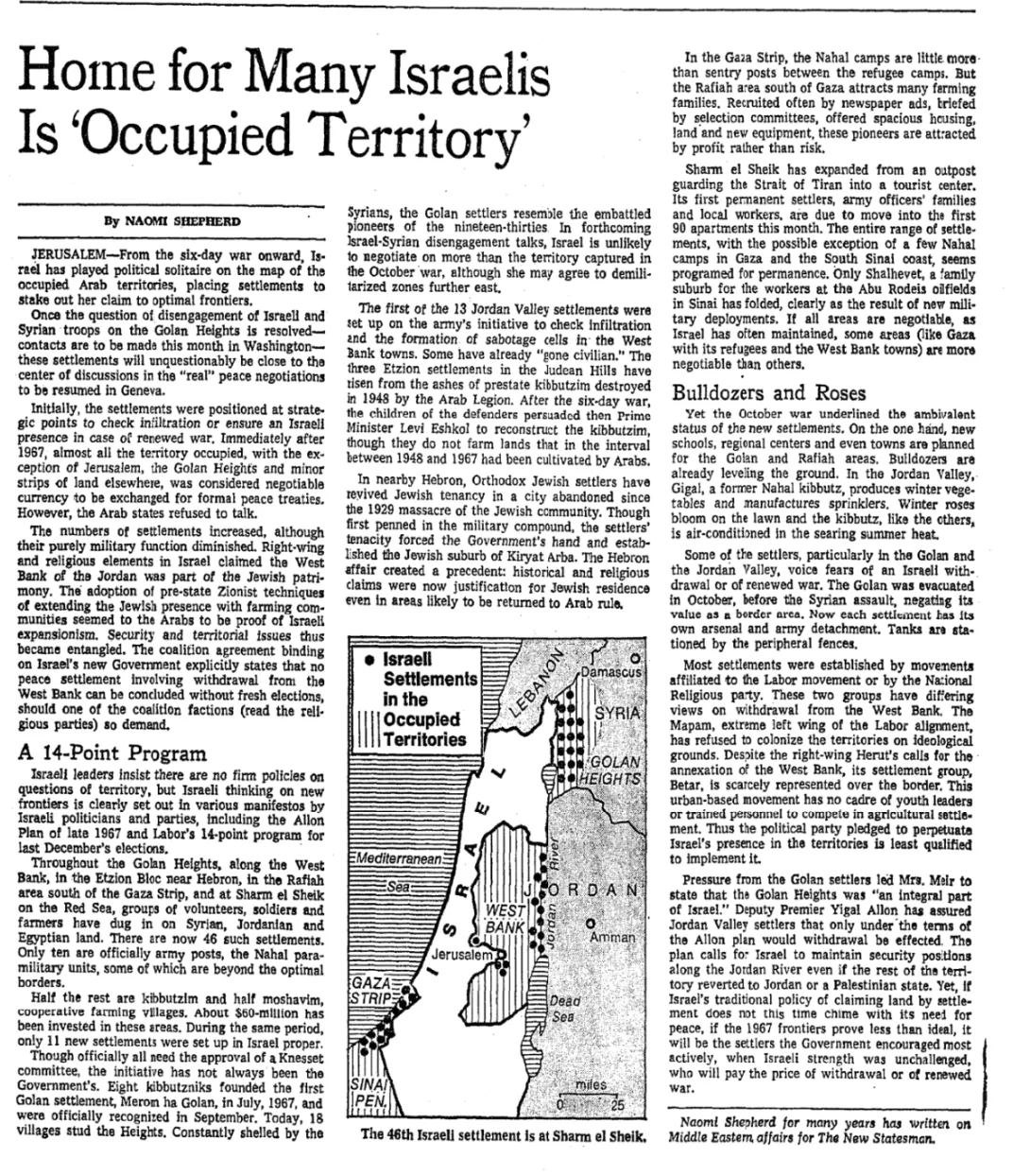
Transcribed from the clipping
JERUSALEM—From the six-day war onward, Israel has played political solitaire on the map of the occupied Arab territories, placing settlements to stake out her claim to optimal frontiers.
Once the question of disengagement of Israeli and Syrian troops on the Golan Heights is resolved—contacts are to be made this month in Washington—these settlements will unquestionably be close to the center of discussions in the “real” peace negotiations to be resumed in Geneva.
Initially, the settlements were positioned at strategic points to check infiltration or ensure an Israeli presence in case of renewed war. Immediately after 1967, almost all the territory occupied, with the exception of Jerusalem, the Golan Heights and minor strips of land elsewhere, was considered negotiable currency to be exchanged for formal peace treaties.
However, the Arab states refused to talk. The numbers of settlements increased, although their purely military function diminished. Right-wing and religious elements in Israel claimed the West Bank of the Jordan was part of the Jewish patrimony.
The first of the 13 Jordan Valley settlements were set up on the army’s initiative to check infiltration and the formation of sabotage cells in the West Bank towns. Some have already “gone civilian.” The three Etzion settlements in the Judean Hills have risen from the ashes of prestate kibbutzim destroyed in 1948 by the Arab Legion.
After the six-day war, the children of the defenders persuaded then Prime Minister Levi Eshkol to reconstruct the kibbutzim, though they do not farm lands that in the interval between 1948 and 1967 had been cultivated by Arabs. In nearby Hebron, Orthodox Jewish settlers have revived Jewish tenancy in a city abandoned since the 1929 massacre of the Jewish community.
Though first penned in the military compound, the settlers’ tenacity forced the Government’s hand and established the Jewish suburb of Kiryat Arba. The Hebron affair created a precedent: historical and religious claims were now justification for Jewish residence even in areas likely to be returned to Arab rule.
In the Gaza Strip, the Nahal camps are little more than sentry posts between the refugee camps. But the Rafiah area south of Gaza attracts many farming families. Recruited often by newspaper ads, briefed by selection committees, offered spacious housing, land and new equipment, these pioneers are attracted by profit rather than risk.
Sharm el Sheik has expanded from an outpost guarding the Strait of Tiran into a tourist center. Its first permanent settlers, army officers’ families and local workers, are due to move into the first 90 apartments this month.
The entire range of settlements, with the possible exception of a few Nahal camps in Gaza and the South Sinai coast, seems programed for permanence. Only Shalhevet, a family suburb for the workers at the Abu Rodeis oilfields in Sinai has folded, clearly as the result of new military deployments.
If all areas are negotiable, as Israel has often maintained, some areas (like Gaza with its refugees and the West Bank towns) are more negotiable than others. Yet the October war underlined the ambivalent status of the new settlements. On the one hand, new schools, regional centers and even towns are planned for the Golan and Rafiah areas.
Bulldozers are already leveling the ground. In the Jordan Valley, Gigal, a former Nahal kibbutz, produces winter vegetables and manufactures sprinklers. Winter roses bloom on the lawn and the kibbutz, like the others, is air-conditioned in the searing summer heat.
Cite this clipping
"Home for Many Israelis Is ‘Occupied Territory’," The New York Times, 17 March 1974. Covering Palestine archive, CP-1974-024. https://coveringpalestine.org/archive/cp-1974-024
More from The New York Times
- The Maine Colony in PalestineThe New York Times · 12 November 1866
- Jewish Colonization in PalestineThe New York Times · 9 December 1883
- Jewish State in Palestine OpposedThe New York Times · 9 July 1897
- ZIONIST CONGRESS IN BASELThe New York Times · 31 August 1897
- ROME FEARS THE ZIONISTSThe New York Times · 12 September 1897
- PROGRESS OF ZIONISMThe New York Times · 16 December 1901
- 852 more from this paper in the full text →
More from the 1970s
- Most Arabs Boycott Jerusalem ElectionThe New York Times · 1 January 1974
- The Terrorist: Intellectual, Radical, a Political LoserThe New York Times · 6 January 1974
- Palestinians Speaking Out Against the Israelis' RuleThe New York Times · 29 January 1974
- Dowry InflationThe Journal Star · 14 February 1974
- ISRAEL ATTACKS LEBANON IN REPRISALEl Paso Herald-Post · 16 May 1974
- Israeli Planes Raid Guerrillas In LebanonTampa Bay Times · 17 May 1974
- All 338 clippings from the 1970s →
Last updated 2 November 2026
This record is part of Covering Palestine, an archive of American newspaper clippings about Palestinians, 1724 to 2023. Researched and assembled by Maria Robles.
The clipping belongs to the newspaper that printed it, or to the news agency that supplied the copy. It is reproduced here for research, criticism and commentary. A city here is where the newspaper was published, not where the story came from, and on most records it was taken from the masthead.
Something wrong here, or something you know about this clipping? The archive is still being built and corrections are wanted: maria@rozumstudio.com, quoting CP-1974-024.
Everything printed in 1974 · Printed on this day · See it in the archive reel · Full text of every clipping · Dataset