The New York Times · 6 January 1974
CP-1974-025
The Terrorist: Intellectual, Radical, a Political Loser
By John L. Hess
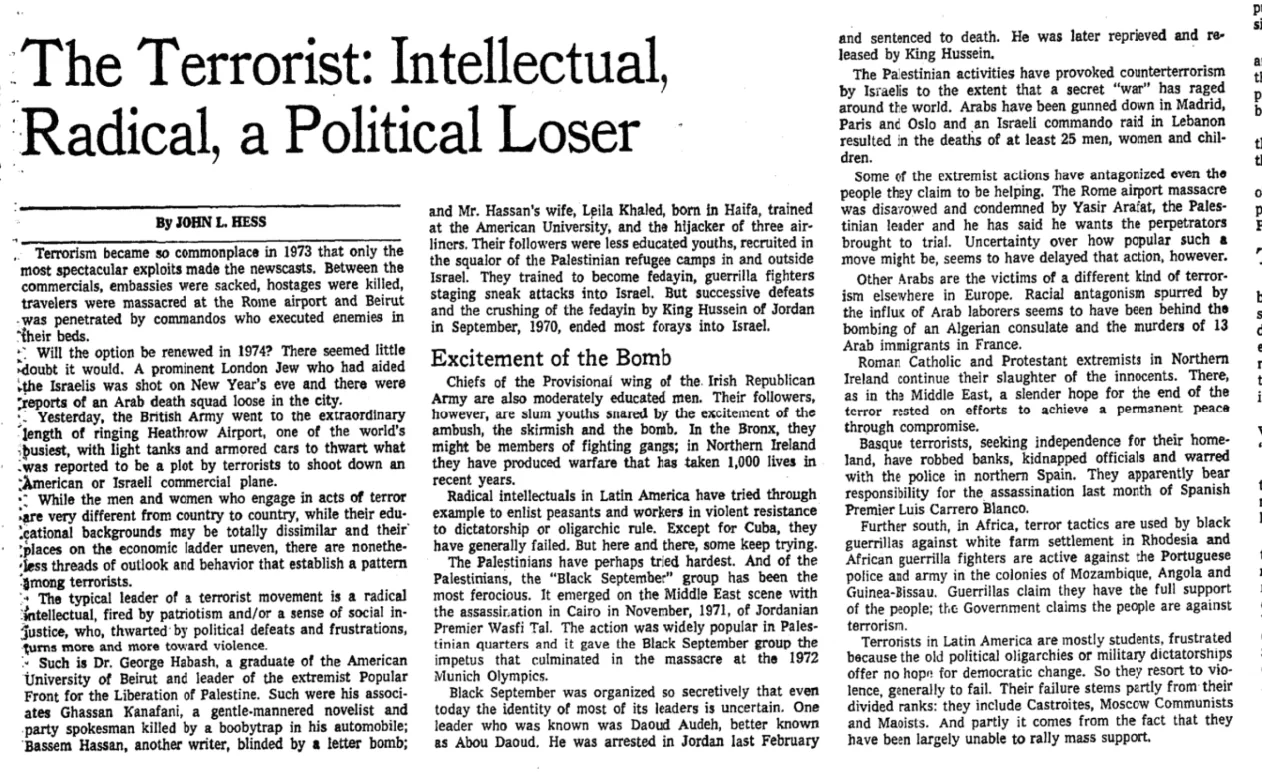
Transcribed from the clipping
Terrorism became so commonplace in 1973 that only the most spectacular exploits made the newscasts. Between the commercials, embassies were sacked, hostages were killed, travelers were massacred at the Rome airport and Beirut was penetrated by commandos who executed enemies in their beds. Will the option be renewed in 1974? There seemed little doubt it would.
A prominent London Jew who had aided the Israelis was shot on New Year’s eve and there were reports of an Arab death squad loose in the city.
Yesterday, the British Army went to the extraordinary length of ringing Heathrow Airport, one of the world’s busiest, with light tanks and armored cars to thwart what was reported to be a plot by terrorists to shoot down an American or Israeli commercial plane.
While the men and women who engage in acts of terror are very different from country to country, while their educational backgrounds may be totally dissimilar and their places on the economic ladder uneven, there are nonetheless threads of outlook and behavior that establish a pattern among terrorists.
The typical leader of a terrorist movement is a radical intellectual, fired by patriotism and/or a sense of social injustice, who, thwarted by political defeats and frustrations, turns more and more toward violence. Such is Dr. George Habash, a graduate of the American University of Beirut and leader of the extremist Popular Front for the Liberation of Palestine.
Such were his associates Ghassan Kanafani, a gentle-mannered novelist and party spokesman killed by a boobytrap in his automobile; Bassem Hassan, another writer, blinded by a letter bomb; and Mr. Hassan’s wife, Leila Khaled, born in Haifa, trained at the American University, and the hijacker of three airliners.
Their followers were less educated youths, recruited in the squalor of the Palestinian refugee camps in and outside Israel. They trained to become fedayin, guerrilla fighters staging sneak attacks into Israel. But successive defeats and the crushing of the fedayin by King Hussein of Jordan in September, 1970, ended most forays into Israel.
Excitement of the Bomb Chiefs of the Provisional wing of the Irish Republican Army are also moderately educated men. Their followers, however, are slum youths snared by the excitement of the ambush, the skirmish and the bomb. In the Bronx, they might be members of fighting gangs; in Northern Ireland they have produced warfare that has taken 1,000 lives in recent years.
Radical intellectuals in Latin America have tried through example to enlist peasants and workers in violent resistance to dictatorship or oligarchic rule. Except for Cuba, they have generally failed. But here and there, some keep trying. The Palestinians have perhaps tried hardest. And of the Palestinians, the “Black September” group has been the most ferocious.
It emerged on the Middle East scene with the assassination in Cairo in November, 1971, of Jordanian Premier Wasfi Tal. The action was widely popular in Palestinian quarters and it gave the Black September group the impetus that culminated in the massacre at the 1972 Munich Olympics.
Black September was organized so secretively that even today the identity of most of its leaders is uncertain. One leader who was known was Daoud Audeh, better known as Abou Daoud. He was arrested in Jordan last February and sentenced to death. He was later reprieved and released by King Hussein.
The Palestinian activities have provoked counterterrorism by Israelis to the extent that a secret “war” has raged around the world. Arabs have been gunned down in Madrid, Paris and Oslo and an Israeli commando raid in Lebanon resulted in the deaths of at least 25 men, women and children.
Some of the extremist actions have antagonized even the people they claim to be helping. The Rome airport massacre was disavowed and condemned by Yasir Arafat, the Palestinian leader and he has said he wants the perpetrators brought to trial. Uncertainty over how popular such a move might be, seems to have delayed that action, however.
Other Arabs are the victims of a different kind of terrorism elsewhere in Europe. Racial antagonism spurred by the influx of Arab laborers seems to have been behind the bombing of an Algerian consulate and the murders of 13 Arab immigrants in France. Roman Catholic and Protestant extremists in Northern Ireland continue their slaughter of the innocents.
There, as in the Middle East, a slender hope for the end of the terror rested on efforts to achieve a permanent peace through compromise. Basque terrorists, seeking independence for their homeland, have robbed banks, kidnapped officials and warred with the police in northern Spain.
They apparently bear responsibility for the assassination last month of Spanish Premier Luis Carrero Blanco. Further south, in Africa, terror tactics are used by black guerrillas against white farm settlement in Rhodesia and African guerrilla fighters are active against the Portuguese police and army in the colonies of Mozambique, Angola and Guinea-Bissau.
Guerrillas claim they have the full support of the people; the Government claims the people are against terrorism. Terrorists in Latin America are mostly students, frustrated because the old political oligarchies or military dictatorships offer no hope for democratic change. So they resort to violence, generally to fail.
Their failure stems partly from their divided ranks: they include Castroites, Moscow Communists and Maoists. And partly it comes from the fact that they have been largely unable to rally mass support.
Cite this clipping
"The Terrorist: Intellectual, Radical, a Political Loser," The New York Times, 6 January 1974. Covering Palestine archive, CP-1974-025. https://coveringpalestine.org/archive/cp-1974-025
More from The New York Times
- The Maine Colony in PalestineThe New York Times · 12 November 1866
- Jewish Colonization in PalestineThe New York Times · 9 December 1883
- Jewish State in Palestine OpposedThe New York Times · 9 July 1897
- ZIONIST CONGRESS IN BASELThe New York Times · 31 August 1897
- ROME FEARS THE ZIONISTSThe New York Times · 12 September 1897
- PROGRESS OF ZIONISMThe New York Times · 16 December 1901
- 852 more from this paper in the full text →
More from the 1970s
- Most Arabs Boycott Jerusalem ElectionThe New York Times · 1 January 1974
- Palestinians Speaking Out Against the Israelis' RuleThe New York Times · 29 January 1974
- Dowry InflationThe Journal Star · 14 February 1974
- Home for Many Israelis Is ‘Occupied Territory’The New York Times · 17 March 1974
- ISRAEL ATTACKS LEBANON IN REPRISALEl Paso Herald-Post · 16 May 1974
- Israeli Planes Raid Guerrillas In LebanonTampa Bay Times · 17 May 1974
- All 338 clippings from the 1970s →
Last updated 2 November 2026
This record is part of Covering Palestine, an archive of American newspaper clippings about Palestinians, 1724 to 2023. Researched and assembled by Maria Robles.
The clipping belongs to the newspaper that printed it, or to the news agency that supplied the copy. It is reproduced here for research, criticism and commentary. A city here is where the newspaper was published, not where the story came from, and on most records it was taken from the masthead.
Something wrong here, or something you know about this clipping? The archive is still being built and corrections are wanted: maria@rozumstudio.com, quoting CP-1974-025.
Everything printed in 1974 · Printed on this day · See it in the archive reel · Full text of every clipping · Dataset