The New York Times · 29 January 1974
CP-1974-027
Palestinians Speaking Out Against the Israelis' Rule
By HENRY KAMM / Special to The New York Times
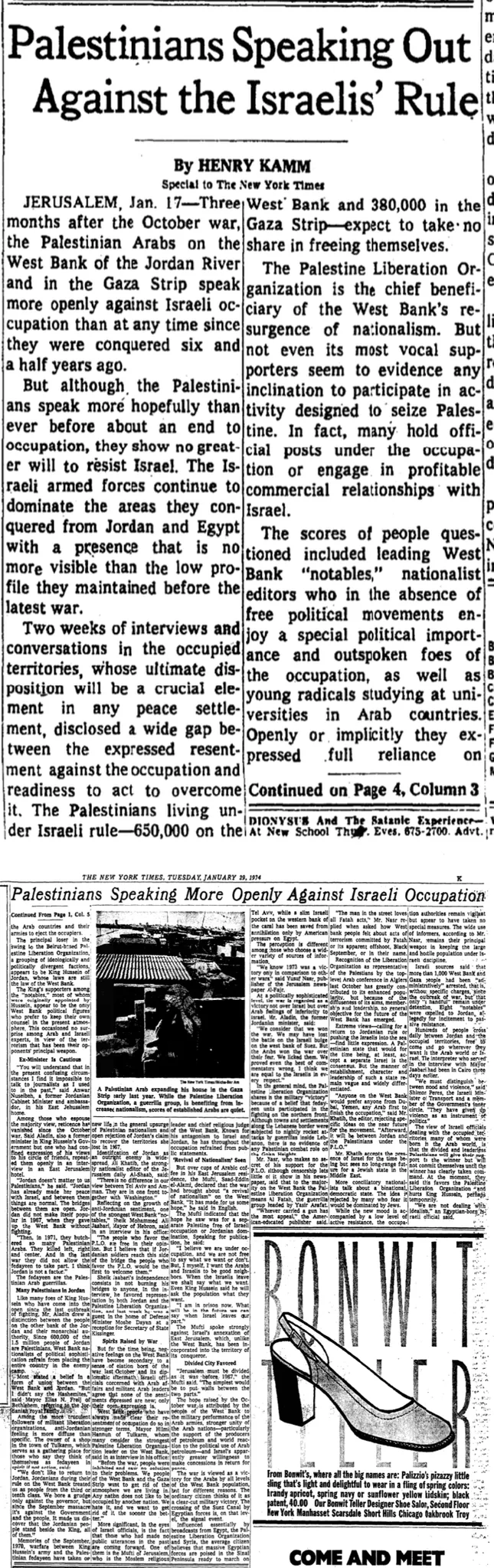
Shown from the top. The whole column — 3.2 times taller than it is wide — is in the enlargement.
Transcribed from the clipping
JERUSALEM, Jan. 17—Three months after the October war, the Palestinian Arabs on the West Bank of the Jordan River and in the Gaza Strip speak more openly against Israeli occupation than at any time since they were conquered six and a half years ago.
But although the Palestinians speak more hopefully than ever before about an end to occupation, they show no greater will to resist Israel. The Israeli armed forces continue to dominate the areas they conquered from Jordan and Egypt with a presence that is no more visible than the low profile they maintained before the latest war.
Two weeks of interviews and conversations in the occupied territories, whose ultimate disposition will be a crucial element in any peace settlement, disclosed a wide gap between the expressed resentment against the occupation and readiness to act to overcome it.
The Palestinians living under Israeli rule—650,000 on the West Bank and 380,000 in the Gaza Strip—expect to take no share in freeing themselves. The Palestine Liberation Organization is the chief beneficiary of the West Bank's resurgence of nationalism.
But not even its most vocal supporters seem to evidence any inclination to participate in activity designed to seize Palestine. In fact, many hold official posts under the occupation or engage in profitable commercial relationships with Israel.
The scores of people questioned included leading West Bank “notables,” nationalist editors who in the absence of free political movements enjoy a special political importance and outspoken foes of the occupation, as well as young radicals studying at universities in Arab countries.
Openly or implicitly they expressed full reliance on the Arab countries and their armies to eject the occupiers. [The jump, page 4:] The principal loser in the swing to the Beirut-based Palestine Liberation Organization, a grouping of ideologically and politically divergent factions, appears to be King Hussein of Jordan, whose laws are still the law of the West Bank.
The King's supporters among the “notables,” most of whose were originally appointed by Hussein, appear to be the only West Bank political figures who prefer to keep their own counsel in the present atmosphere. This occasioned no surprise among Arab and Israeli experts, in view of the terrorism that has been their opponents' principal weapon.
Ex-Minister Is Cautious “You will understand that in the present confusing circumstances I find it impossible to talk to journalists as I used to in the past,” said Anwar Nuseibeh, a former Jordanian Cabinet Minister and ambassador, in his East Jerusalem home. Among those who espouse the majority view, reticence has vanished since the October war.
Said Aladin, also a former minister in King Hussein's Government but one who had confined expression of his views to his circle of friends, repeated them openly in an interview in an East Jerusalem hotel. “Jordan doesn't matter to us Palestinians,” he said. “Jordan has already made her peace with Israel, and between them things are normal. The bridges between them are open.
Jordan did not make itself popular in 1967, when they gave up the West Bank without fighting. “Then, in 1971, they butchered so many Palestinian Arabs. They killed left, right and center. And in the last war they did not allow the fedayeen to take part.
I think Jordan is not a factor.” [Later in the jump:] But over cups of Arabic coffee in his East Jerusalem residence, the Mufti, Saad-Eddin al-Alami, declared that the war had brought about “a revival of nationalism” on the West Bank. “It has made for us some hope,” he said in English.
How this transcription was made
Assembled from 2 scans, as Maria's label directs, and they do belong together: the page-one column ends "Openly or implicitly they expressed full reliance on" / "Continued on Page 4, Column 3," and the jump opens "Continued From Page 1, Col. 5" / "the Arab countries and their armies to eject the occupiers." The sentence closes across the two scans exactly. The bylines match and the jump headline is the page-four variant, "Palestinians Speaking More Openly Against Israeli Occupation." Read at 9x-22x. The jump is very long — seven columns of dense type running nearly the full page depth — and is NOT transcribed in full. The excerpt gives the complete page-one text, the opening of the jump, and two verified passages further down; the omissions are marked with bracketed notes. The remainder (on Sheik Mohammed Ali Jaabari of Hebron, Mayor Hilmi Hannun of Tulkarm, Yusuf Nasr of Al-Fajr, Israeli deportations and administrative detentions, and the Israeli reaction) was read at the page level but not transcribed at magnification and should not be treated as transcribed. A Bonwit Teller shoe advertisement occupies the lower right quarter of page 4 and is not part of the article. One typographic note: in the Said Aladin quotation the paper sets what appears to be a stray parenthesis after "itself" ("did not make itself( popular"); I read it as a damaged comma or broken sort rather than an intended character and have not reproduced it. — Two clippings of one article, joined into a single image for the record (s074_1.png, s074_2.png). One transcription slip corrected on 2 Nov 2026: the excerpt read “East Jehusalem”; a magnified re-read of the scan gives “East Jerusalem”.
Cite this clipping
"Palestinians Speaking Out Against the Israelis' Rule," The New York Times, 29 January 1974, p. 1 (jump to page 4, column 3). Covering Palestine archive, CP-1974-027. https://coveringpalestine.org/archive/cp-1974-027
More from The New York Times
- The Maine Colony in PalestineThe New York Times · 12 November 1866
- Jewish Colonization in PalestineThe New York Times · 9 December 1883
- Jewish State in Palestine OpposedThe New York Times · 9 July 1897
- ZIONIST CONGRESS IN BASELThe New York Times · 31 August 1897
- ROME FEARS THE ZIONISTSThe New York Times · 12 September 1897
- PROGRESS OF ZIONISMThe New York Times · 16 December 1901
- 852 more from this paper in the full text →
More from the 1970s
- Most Arabs Boycott Jerusalem ElectionThe New York Times · 1 January 1974
- The Terrorist: Intellectual, Radical, a Political LoserThe New York Times · 6 January 1974
- Dowry InflationThe Journal Star · 14 February 1974
- Home for Many Israelis Is ‘Occupied Territory’The New York Times · 17 March 1974
- ISRAEL ATTACKS LEBANON IN REPRISALEl Paso Herald-Post · 16 May 1974
- Israeli Planes Raid Guerrillas In LebanonTampa Bay Times · 17 May 1974
- All 338 clippings from the 1970s →
Last updated 2 November 2026
This record is part of Covering Palestine, an archive of American newspaper clippings about Palestinians, 1724 to 2023. Researched and assembled by Maria Robles.
The clipping belongs to the newspaper that printed it, or to the news agency that supplied the copy. It is reproduced here for research, criticism and commentary. A city here is where the newspaper was published, not where the story came from, and on most records it was taken from the masthead.
Something wrong here, or something you know about this clipping? The archive is still being built and corrections are wanted: maria@rozumstudio.com, quoting CP-1974-027.
Everything printed in 1974 · Printed on this day · See it in the archive reel · Full text of every clipping · Dataset