The New York Times · 1 January 1974
CP-1974-028
Most Arabs Boycott Jerusalem Election
By HENRY KAMM
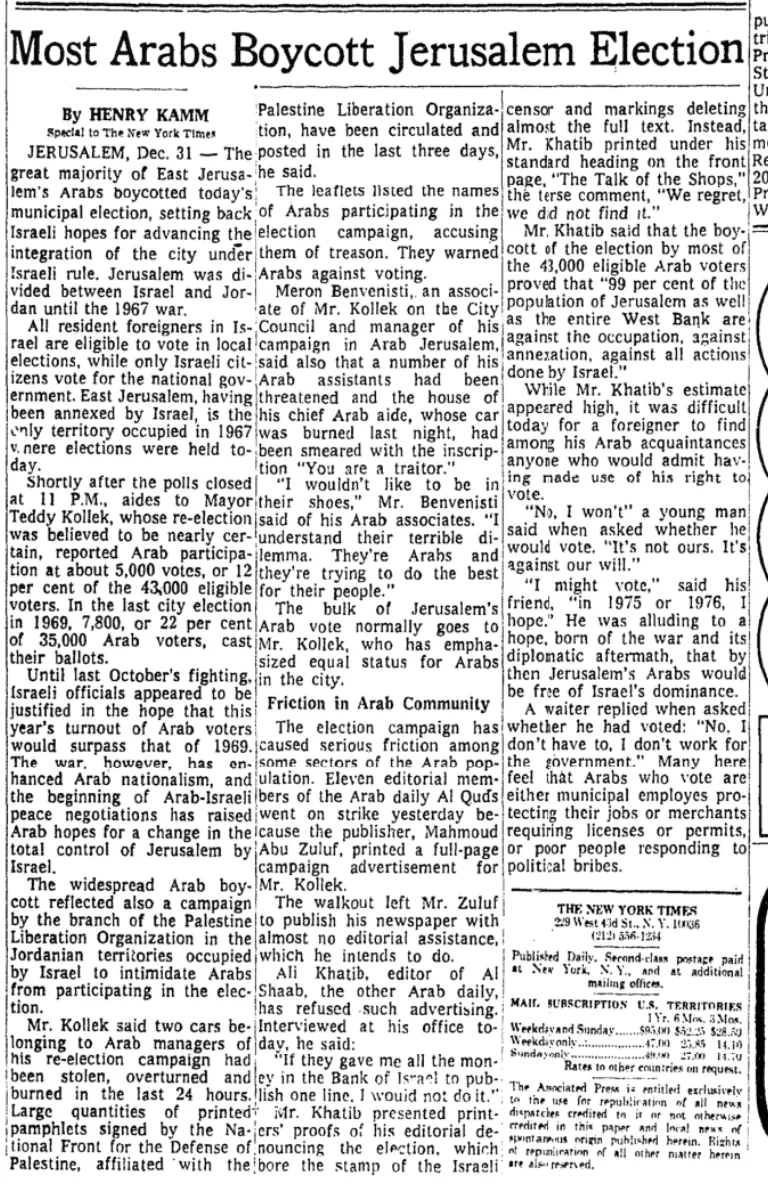
Transcribed from the clipping
JERUSALEM, Dec. 31 — The great majority of East Jerusalem's Arabs boycotted today's municipal election, setting back Israeli hopes for advancing the integration of the city under Israeli rule. Jerusalem was divided between Israel and Jordan until the 1967 war.
All resident foreigners in Israel are eligible to vote in local elections, while only Israeli citizens vote for the national government. East Jerusalem, having been annexed by Israel, is the only territory occupied in 1967 where elections were held today.
Shortly after the polls closed at 11 P.M., aides to Mayor Teddy Kollek, whose re-election was believed to be nearly certain, reported Arab participation at about 5,000 votes, or 12 per cent of the 43,000 eligible voters. In the last city election in 1969, 7,800, or 22 per cent of 35,000 Arab voters, cast their ballots.
Until last October's fighting, Israeli officials appeared to be justified in the hope that this year's turnout of Arab voters would surpass that of 1969. The war, however, has enhanced Arab nationalism, and the beginning of Arab-Israeli peace negotiations has raised Arab hopes for a change in the total control of Jerusalem by Israel.
The widespread Arab boycott reflected also a campaign by the branch of the Palestine Liberation Organization in the Jordanian territories occupied by Israel to intimidate Arabs from participating in the election. Mr. Kollek said two cars belonging to Arab managers of his re-election campaign had been stolen, overturned and burned in the last 24 hours.
Large quantities of printed pamphlets signed by the National Front for the Defense of Palestine, affiliated with the Palestine Liberation Organization, have been circulated and posted in the last three days, he said. The leaflets listed the names of Arabs participating in the election campaign, accusing them of treason. They warned Arabs against voting.
Meron Benvenisti, an associate of Mr. Kollek on the City Council and manager of his campaign in Arab Jerusalem, said also that a number of his Arab assistants had been threatened and the house of his chief Arab aide, whose car was burned last night, had been smeared with the inscription “You are a traitor.” “I wouldn't like to be in their shoes,” Mr.
Benvenisti said of his Arab associates. “I understand their terrible dilemma. They're Arabs and they're trying to do the best for their people.” The bulk of Jerusalem's Arab vote normally goes to Mr. Kollek, who has emphasized equal status for Arabs in the city.
Friction in Arab Community The election campaign has caused serious friction among some sectors of the Arab population. Eleven editorial members of the Arab daily Al Quds went on strike yesterday because the publisher, Mahmoud Abu Zuluf, printed a full-page campaign advertisement for Mr. Kollek. The walkout left Mr.
Zuluf to publish his newspaper with almost no editorial assistance, which he intends to do. Ali Khatib, editor of Al Shaab, the other Arab daily, has refused such advertising. Interviewed at his office today, he said: “If they gave me all the money in the Bank of Israel to publish one line, I would not do it.” Mr.
Khatib presented printers' proofs of his editorial denouncing the election, which bore the stamp of the Israeli censor and markings deleting almost the full text. Instead, Mr. Khatib printed under his standard heading on the front page, “The Talk of the Shops,” the terse comment, “We regret, we did not find it.” Mr.
Khatib said that the boycott of the election by most of the 43,000 eligible Arab voters proved that “99 per cent of the population of Jerusalem as well as the entire West Bank are against the occupation, against annexation, against all actions done by Israel.” While Mr.
Khatib's estimate appeared high, it was difficult today for a foreigner to find among his Arab acquaintances anyone who would admit having made use of his right to vote. “No, I won't” a young man said when asked whether he would vote. “It's not ours. It's against our will.” “I might vote,” said his friend, “in 1975 or 1976, I hope.”
He was alluding to a hope, born of the war and its diplomatic aftermath, that by then Jerusalem's Arabs would be free of Israel's dominance. A waiter replied when asked whether he had voted: “No, I don't have to, I don't work for the government.”
Many here feel that Arabs who vote are either municipal employes protecting their jobs or merchants requiring licenses or permits, or poor people responding to political bribes.
How this transcription was made
Confirmed twice on the page: the byline block reads 'Special to The New York Times', and the paper's own imprint box at the foot of the third column reads 'THE NEW YORK TIMES / 229 West 43d St., N.Y. 10036 / (212) 556-1234' with subscription rates and the AP republication notice. — No masthead date on the cut. The dateline reads 'JERUSALEM, Dec. 31' and the election is 'today', so a Jan. 1 paper fits Maria's label. The year is fixed by internal evidence to 1973–74: 'Until last October's fighting', 'the last city election in 1969', and a young man hoping to vote 'in 1975 or 1976'. That makes this the Jerusalem municipal election of Dec. 31 1973, reported Jan. 1 1974 — Maria's label is right. — Maria's slide label lists the June 29 1982 censorship piece first and the Jan 1 1974 piece second, but the images are in the opposite order: this is s054_1 and it is the 1974 story. — The whole article, read at magnification across three columns. The paper sets 'per cent' as two words and 'employes' without the second e — both as printed. The missing comma in '“No, I won't” a young man said' is also as printed.
Cite this clipping
"Most Arabs Boycott Jerusalem Election," The New York Times, 1 January 1974. Covering Palestine archive, CP-1974-028. https://coveringpalestine.org/archive/cp-1974-028
More from The New York Times
- The Maine Colony in PalestineThe New York Times · 12 November 1866
- Jewish Colonization in PalestineThe New York Times · 9 December 1883
- Jewish State in Palestine OpposedThe New York Times · 9 July 1897
- ZIONIST CONGRESS IN BASELThe New York Times · 31 August 1897
- ROME FEARS THE ZIONISTSThe New York Times · 12 September 1897
- PROGRESS OF ZIONISMThe New York Times · 16 December 1901
- 852 more from this paper in the full text →
More from the 1970s
- The Terrorist: Intellectual, Radical, a Political LoserThe New York Times · 6 January 1974
- Palestinians Speaking Out Against the Israelis' RuleThe New York Times · 29 January 1974
- Dowry InflationThe Journal Star · 14 February 1974
- Home for Many Israelis Is ‘Occupied Territory’The New York Times · 17 March 1974
- ISRAEL ATTACKS LEBANON IN REPRISALEl Paso Herald-Post · 16 May 1974
- Israeli Planes Raid Guerrillas In LebanonTampa Bay Times · 17 May 1974
- All 338 clippings from the 1970s →
Last updated 2 November 2026
This record is part of Covering Palestine, an archive of American newspaper clippings about Palestinians, 1724 to 2023. Researched and assembled by Maria Robles.
The clipping belongs to the newspaper that printed it, or to the news agency that supplied the copy. It is reproduced here for research, criticism and commentary. A city here is where the newspaper was published, not where the story came from, and on most records it was taken from the masthead.
Something wrong here, or something you know about this clipping? The archive is still being built and corrections are wanted: maria@rozumstudio.com, quoting CP-1974-028.
Everything printed in 1974 · Printed on this day · See it in the archive reel · Full text of every clipping · Dataset