The Boston Globe · 15 April 1984
CP-1984-046
Arab editors say tension sharpens censor's scissors
By Michael Widlanski
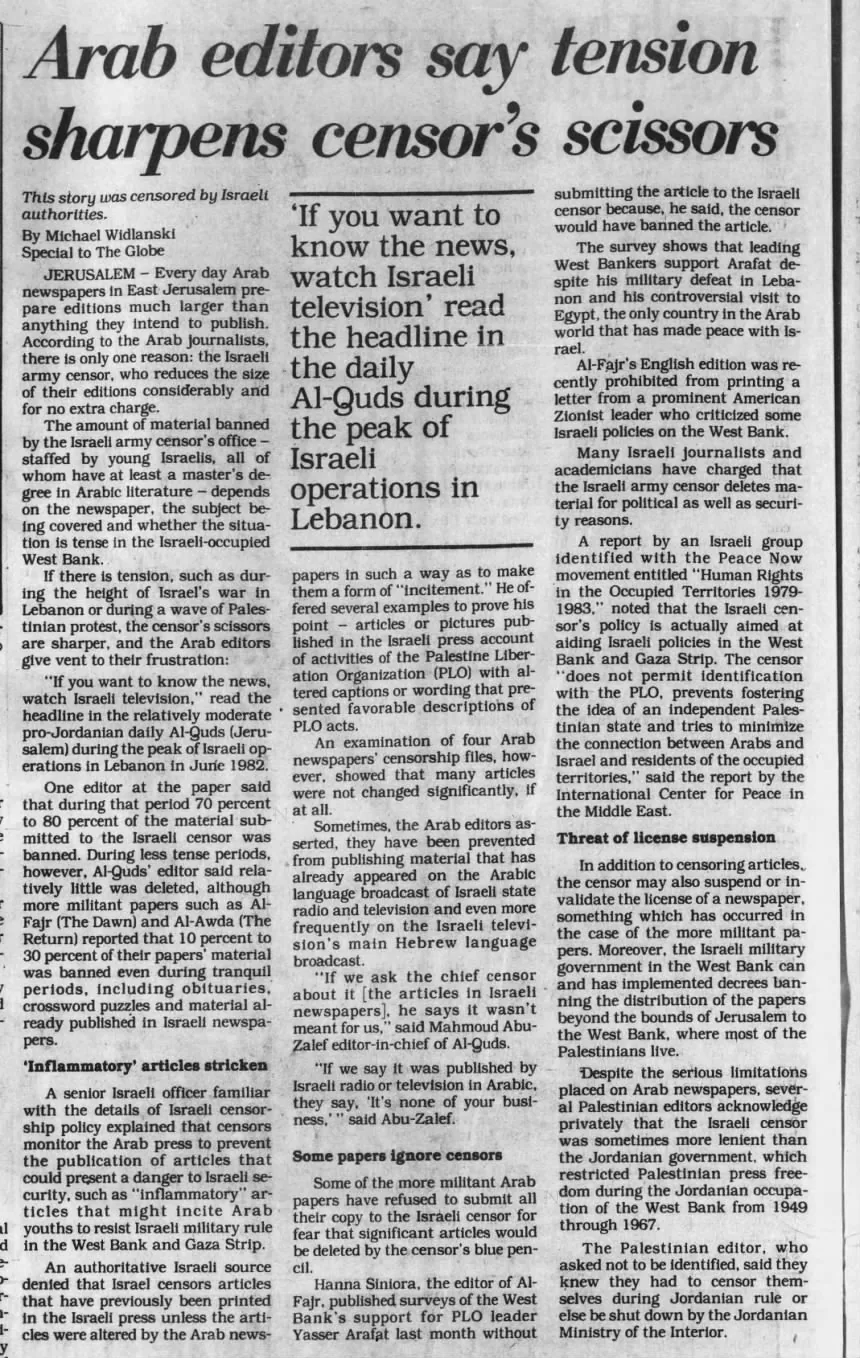
Transcribed from the clipping
This story was censored by Israeli authorities. JERUSALEM — Every day Arab newspapers in East Jerusalem prepare editions much larger than anything they intend to publish. According to the Arab journalists, there is only one reason: the Israeli army censor, who reduces the size of their editions considerably and for no extra charge.
The amount of material banned by the Israeli army censor's office — staffed by young Israelis, all of whom have at least a master's degree in Arabic literature — depends on the newspaper, the subject being covered and whether the situation is tense in the Israeli-occupied West Bank.
If there is tension, such as during the height of Israel's war in Lebanon or during a wave of Palestinian protest, the censor's scissors are sharper, and the Arab editors give vent to their frustration: “If you want to know the news, watch Israeli television,” read the headline in the relatively moderate pro-Jordanian daily Al-Quds (Jerusalem) during the peak of Israeli operations in Lebanon in June 1982.
One editor at the paper said that during that period 70 percent to 80 percent of the material submitted to the Israeli censor was banned.
During less tense periods, however, Al-Quds' editor said relatively little was deleted, although more militant papers such as Al-Fajr (The Dawn) and Al-Awda (The Return) reported that 10 percent to 30 percent of their papers' material was banned even during tranquil periods, including obituaries, crossword puzzles and material already published in Israeli newspapers.
‘Inflammatory’ articles stricken A senior Israeli officer familiar with the details of Israeli censorship policy explained that censors monitor the Arab press to prevent the publication of articles that could present a danger to Israeli security, such as “inflammatory” articles that might incite Arab youths to resist Israeli military rule in the West Bank and Gaza Strip.
An authoritative Israeli source denied that Israel censors articles that have previously been printed in the Israeli press unless the articles were altered by the Arab newspapers in such a way as to make them a form of “incitement.”
He offered several examples to prove his point — articles or pictures published in the Israeli press account of activities of the Palestine Liberation Organization (PLO) with altered captions or wording that presented favorable descriptions of PLO acts.
An examination of four Arab newspapers' censorship files, however, showed that many articles were not changed significantly, if at all.
Sometimes, the Arab editors asserted, they have been prevented from publishing material that has already appeared on the Arabic language broadcast of Israeli state radio and television and even more frequently on the Israeli television's main Hebrew language broadcast.
“If we ask the chief censor about it [the articles in Israeli newspapers], he says it wasn't meant for us,” said Mahmoud Abu-Zalef editor-in-chief of Al-Quds. “If we say it was published by Israeli radio or television in Arabic, they say, ‘It's none of your business,’” said Abu-Zalef.
Some papers ignore censors Some of the more militant Arab papers have refused to submit all their copy to the Israeli censor for fear that significant articles would be deleted by the censor's blue pencil.
Hanna Siniora, the editor of Al-Fajr, published surveys of the West Bank's support for PLO leader Yasser Arafat last month without submitting the article to the Israeli censor because, he said, the censor would have banned the article.
How this transcription was made
The clipping identifies its own paper: the credit line reads “Special to The Globe”, which is the Boston Globe’s staff credit, and Maria’s slide label says Boston Globe. Recorded 2 November 2026. No masthead appears on the scan. Masthead not readable on the scan. The label on the slide read: UNCONFIRMED by masthead, but the paper identifies itself in the credit line: “Special to The Globe”. Maria's slide label pairs this slide as “Chicago Tribune July 7 1982 / Boston Globe April 15 1984” — this is the BOSTON GLOBE item, the SECOND label, not the first. — ORDER REVERSED ON THIS SLIDE. Maria's label reads “Chicago Tribune July 7 1982 / Boston Globe April 15 1984”, which maps the first image to the Chicago Tribune. The pages say the opposite: s081_1 carries “Special to The Globe” and 1984 content, and s081_2 is a Ron Alridge TV-radio column citing Chicago radio stations (WGCI, WBMX, WJPC, WVON) and the June 1982 Arafat interview. The two labels belong to the two images in reverse order. Do not ingest by position. — A large-type pull quote occupies the top of column two — “‘If you want to know the news, watch Israeli television’ read the headline in the daily Al-Quds during the peak of Israeli operations in Lebanon.” Per the deck rule this is a pull quote, not a deck, so dek is empty.
Cite this clipping
"Arab editors say tension sharpens censor's scissors," The Boston Globe, 15 April 1984. Covering Palestine archive, CP-1984-046. https://coveringpalestine.org/archive/cp-1984-046
More from The Boston Globe
- ON WAR-TRODDEN FIELDSThe Boston Globe · 27 December 1914
- Palestine and Its Problems: Keeping Jews and Arabs ApartThe Boston Globe · 9 August 1935
- 7 Syrians Killed in Rioting Over Palestine PartitionThe Boston Globe · 1 December 1947
- Jaffa Is a Dead CityThe Boston Globe · 14 May 1948
- Palestinian Arabs Ready to Live With Jewish “Cousins”The Boston Globe · 2 October 1948
- On UN resolution branding Zionism as racistThe Boston Globe · 17 November 1975
- 27 more from this paper in the full text →
More from the 1980s
- Shamir meets Israel's Arab citizensThe New York Times · 5 January 1984
- Cultural-hatred roots run deep in West BankThe Oregonian · 5 January 1984
- P.L.O. IdeologistsThe New York Times · 12 January 1984
- Bedouin Herdsmen Arrested In Negev Stabbing IncidentThe New York Times · 17 January 1984
- Israeli police stoned; Palestinian killedJackson Citizen Patriot · 29 January 1984
- Zionists attack Palestinian busThe Columbian · 5 March 1984
- All 527 clippings from the 1980s →
Last updated 2 November 2026
This record is part of Covering Palestine, an archive of American newspaper clippings about Palestinians, 1724 to 2023. Researched and assembled by Maria Robles.
The clipping belongs to the newspaper that printed it, or to the news agency that supplied the copy. It is reproduced here for research, criticism and commentary. A city here is where the newspaper was published, not where the story came from, and on most records it was taken from the masthead.
Something wrong here, or something you know about this clipping? The archive is still being built and corrections are wanted: maria@rozumstudio.com, quoting CP-1984-046.
Everything printed in 1984 · Printed on this day · See it in the archive reel · Full text of every clipping · Dataset