The New York Times · New York, New York · 21 May 1989
CP-1989-028
For 7 Palestinians Accused in the Uprising, Common Thread Is Journalism
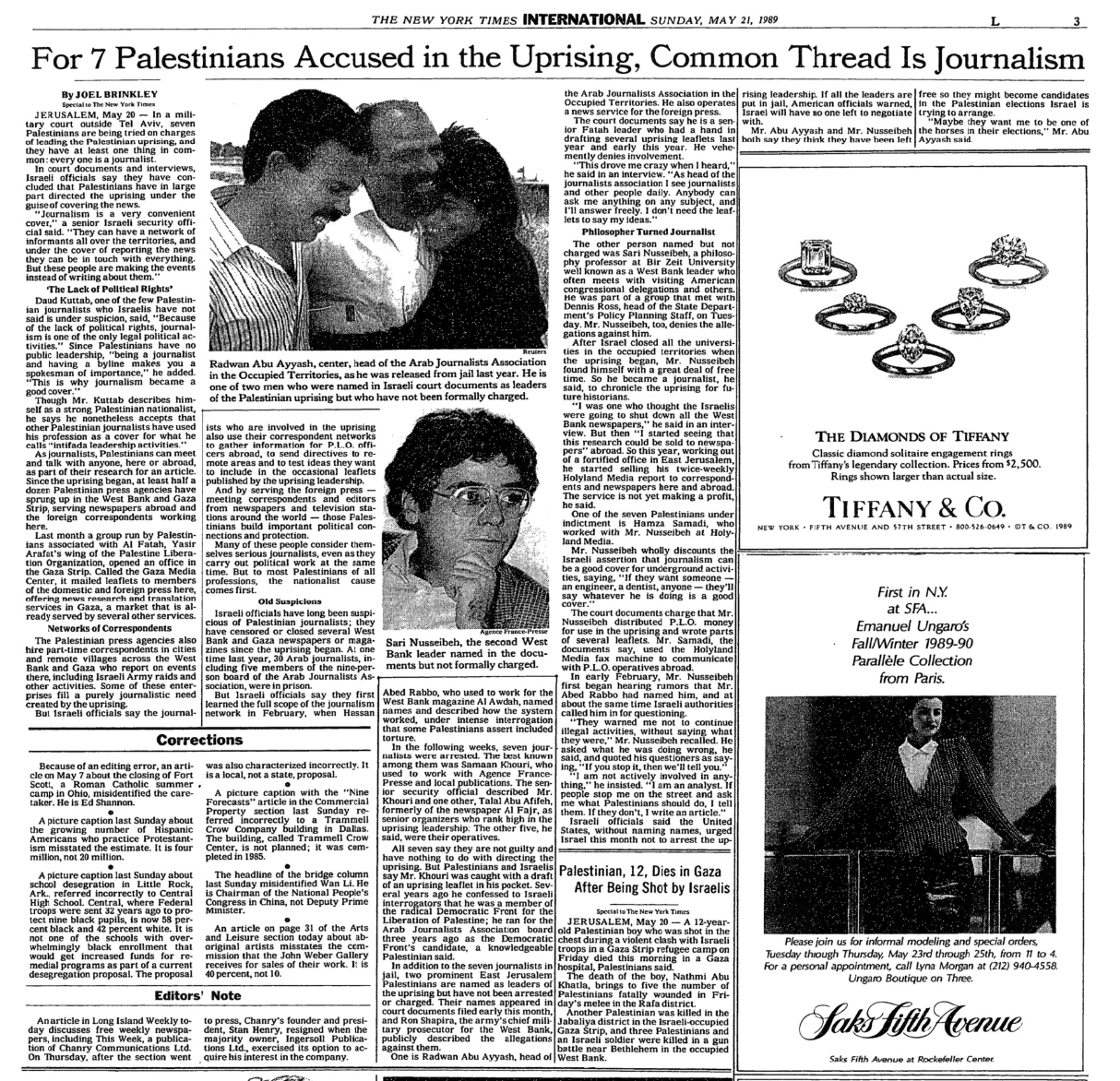
Transcribed from the clipping
JERUSALEM, May 20 — In a military court outside Tel Aviv, seven Palestinians are being tried on charges of leading the Palestinian uprising, and they have at least one thing in common: every one is a journalist.
In court documents and interviews, Israeli officials say they have concluded that Palestinians have in large part directed the uprising under the guise of covering the news. “Journalism is a very convenient cover,” a senior Israeli security official said.
“They can have a network of informants all over the territories, and under the cover of reporting the news they can be in touch with everything. But these people are making the events instead of writing about them.”
‘The Lack of Political Rights’ Daud Kuttab, one of the few Palestinian journalists who Israelis have not said is under suspicion, said, “Because of the lack of political rights, journalism is one of the only legal political activities.” Since Palestinians have no public leadership, “being a journalist and having a byline makes you a spokesman of importance,” he added.
“This is why journalism became a good cover.” Though Mr. Kuttab describes himself as a strong Palestinian nationalist, he says he nonetheless accepts that other Palestinian journalists have used his profession as a cover for what he calls “intifada leadership activities.”
As journalists, Palestinians can meet and talk with anyone, here or abroad, as part of their research for an article. Since the uprising began, at least half a dozen Palestinian press agencies have sprung up in the West Bank and Gaza Strip, serving newspapers abroad and the foreign correspondents working here.
Last month a group run by Palestinians associated with Al Fatah, Yasir Arafat’s wing of the Palestine Liberation Organization, opened an office in the Gaza Strip. Called the Gaza Media Center, it mailed leaflets to members of the domestic and foreign press here, offering news research and translation services in Gaza, a market that is already served by several other services.
Networks of Correspondents The Palestinian press agencies also hire part-time correspondents in cities and remote villages across the West Bank and Gaza who report on events there, including Israeli Army raids and other activities. Some of these enterprises fill a purely journalistic need created by the uprising.
But Israeli officials say the journalists who are involved in the uprising also use their correspondent networks to gather information for P.L.O. officers abroad, to send directives to remote areas and to test ideas they want to include in the occasional leaflets published by the uprising leadership.
And by serving the foreign press — meeting correspondents and editors from newspapers and television stations around the world — those Palestinians build important political connections and protection. Many of these people consider themselves serious journalists, even as they carry out political work at the same time.
But to most Palestinians of all professions, the nationalist cause comes first. Old Suspicions Israeli officials have long been suspicious of Palestinian journalists; they have censored or closed several West Bank and Gaza newspapers or magazines since the uprising began.
At one time last year, 30 Arab journalists, including five members of the nine-person board of the Arab Journalists Association, were in prison.
But Israeli officials say they first learned the full scope of the journalism network in February, when Hassan Abed Rabbo, who used to work for the West Bank magazine Al Awdah, named names and described how the system worked, under intense interrogation that some Palestinians assert included torture. In the following weeks, seven journalists were arrested.
The best known among them was Samaan Khouri, who used to work with Agence France-Presse and local publications. The senior security official described Mr. Khouri and one other, Talal Abu Afifeh, formerly of the newspaper Al Fajr, as senior organizers who rank high in the uprising leadership. The other five, he said, were their operatives.
All seven say they are not guilty and have nothing to do with directing the uprising. But Palestinians and Israelis say Mr. Khouri was caught with a draft of an uprising leaflet in his pocket.
Several years ago he confessed to Israeli interrogators that he was a member of the radical Democratic Front for the Liberation of Palestine; he ran for the Arab Journalists Association board three years ago as the Democratic Front’s candidate, a knowledgeable Palestinian said.
In addition to the seven journalists in jail, two prominent East Jerusalem Palestinians are named as leaders of the uprising but have not been arrested or charged. Their names appeared in court documents filed early this month, and Ron Shapira, the army’s chief military prosecutor for the West Bank, publicly described the allegations against them.
One is Radwan Abu Ayyash, head of the Arab Journalists Association in the Occupied Territories. He also operates a news service for the foreign press. The court documents say he is a senior Fatah leader who had a hand in drafting several uprising leaflets last year and early this year. He vehemently denies involvement.
“This drove me crazy when I heard,” he said in an interview. “As head of the journalists association I see journalists and other people daily. Anybody can ask me anything on any subject, and I’ll answer freely. I don’t need the leaflets to say my ideas.”
Philosopher Turned Journalist The other person named but not charged was Sari Nusseibeh, a philosophy professor at Bir Zeit University well known as a West Bank leader who often meets with visiting American congressional delegations and others. He was part of a group that met with Dennis Ross, head of the State Department’s Policy Planning Staff, on Tuesday. Mr.
Nusseibeh, too, denies the allegations against him. After Israel closed all the universities in the occupied territories when the uprising began, Mr. Nusseibeh found himself with a great deal of free time. So he became a journalist, he said, to chronicle the uprising for future historians.
“I was one who thought the Israelis were going to shut down all the West Bank newspapers,” he said in an interview. But then “I started seeing that this research could be sold to newspapers” abroad. So this year, working out of a fortified office in East Jerusalem, he started selling his twice-weekly Holyland Media report to correspondents and newspapers here and abroad.
The service is not yet making a profit, he said. One of the seven Palestinians under indictment is Hamza Samadi, who worked with Mr. Nusseibeh at Holyland Media. Mr.
Nusseibeh wholly discounts the Israeli assertion that journalism can be a good cover for underground activities, saying, “If they want someone — an engineer, a dentist, anyone — they’ll say whatever he is doing is a good cover.” The court documents charge that Mr. Nusseibeh distributed P.L.O. money for use in the uprising and wrote parts of several leaflets. Mr.
Samadi, the documents say, used the Holyland Media fax machine to communicate with P.L.O. operatives abroad. In early February, Mr. Nusseibeh first began hearing rumors that Mr. Abed Rabbo had named him, and at about the same time Israeli authorities called him in for questioning. “They warned me not to continue illegal activities, without saying what they were,” Mr.
Nusseibeh recalled. He asked what he was doing wrong, he said, and quoted his questioners as saying, “If you stop it, then we’ll tell you.” “I am not actively involved in anything,” he insisted. “I am an analyst. If people stop me on the street and ask me what Palestinians should do, I tell them. If they don’t, I write an article.”
Israeli officials said the United States, without naming names, urged Israel this month not to arrest the uprising leadership. If all the leaders are put in jail, American officials warned, Israel will have no one left to negotiate with. Mr. Abu Ayyash and Mr.
Nusseibeh both say they think they have been left free so they might become candidates in the Palestinian elections Israel is trying to arrange. “Maybe they want me to be one of the horses in their elections,” Mr. Abu Ayyash said.
How this transcription was made
Read from the scan by a machine looking at the image of the page, not by optical character recognition and not by a person. The printed date on the page agrees with the date recorded here.
Context added by this archive
This clipping and CP-1989-030 are two stories printed on the same sheet of newsprint, which is why they share a scan. They are separate records because they are separate articles with their own headlines and datelines, and merging them would attach one story’s dateline to the other.
Cite this clipping
"For 7 Palestinians Accused in the Uprising, Common Thread Is Journalism," The New York Times, 21 May 1989, p. 3. Covering Palestine archive, CP-1989-028. https://coveringpalestine.org/archive/cp-1989-028
More from The New York Times
- The Maine Colony in PalestineThe New York Times · 12 November 1866
- Jewish Colonization in PalestineThe New York Times · 9 December 1883
- Jewish State in Palestine OpposedThe New York Times · 9 July 1897
- ZIONIST CONGRESS IN BASELThe New York Times · 31 August 1897
- ROME FEARS THE ZIONISTSThe New York Times · 12 September 1897
- PROGRESS OF ZIONISMThe New York Times · 16 December 1901
- 852 more from this paper in the full text →
More from the 1980s
- ArafatThe Times · 18 January 1989
- Israeli officials play down offer from Shamir to withdraw troopsThe Miami Herald · 3 February 1989
- Shamir offer not newWorcester Telegram · 3 February 1989
- Israelis Study Devices In Blasts in West BankThe New York Times · 16 February 1989
- Can't rule, absorb, bar or expel PalestiniansSt. Louis Jewish Light · 3 March 1989
- THE AMBIGUOUS YASIR ARAFATThe New York Times · 12 March 1989
- All 527 clippings from the 1980s →
Last updated 2 November 2026
This record is part of Covering Palestine, an archive of American newspaper clippings about Palestinians, 1724 to 2023. Researched and assembled by Maria Robles.
The clipping belongs to the newspaper that printed it, or to the news agency that supplied the copy. It is reproduced here for research, criticism and commentary. A city here is where the newspaper was published, not where the story came from, and on most records it was taken from the masthead.
Something wrong here, or something you know about this clipping? The archive is still being built and corrections are wanted: maria@rozumstudio.com, quoting CP-1989-028.
Everything printed in 1989 · Printed on this day · See it in the archive reel · Full text of every clipping · Dataset