The New York Times · 7 May 1992
CP-1992-022
To a Novelist of Nazareth, Laurels and Loud Boos
A salute from Israel brings down the wrath of many Palestinians.
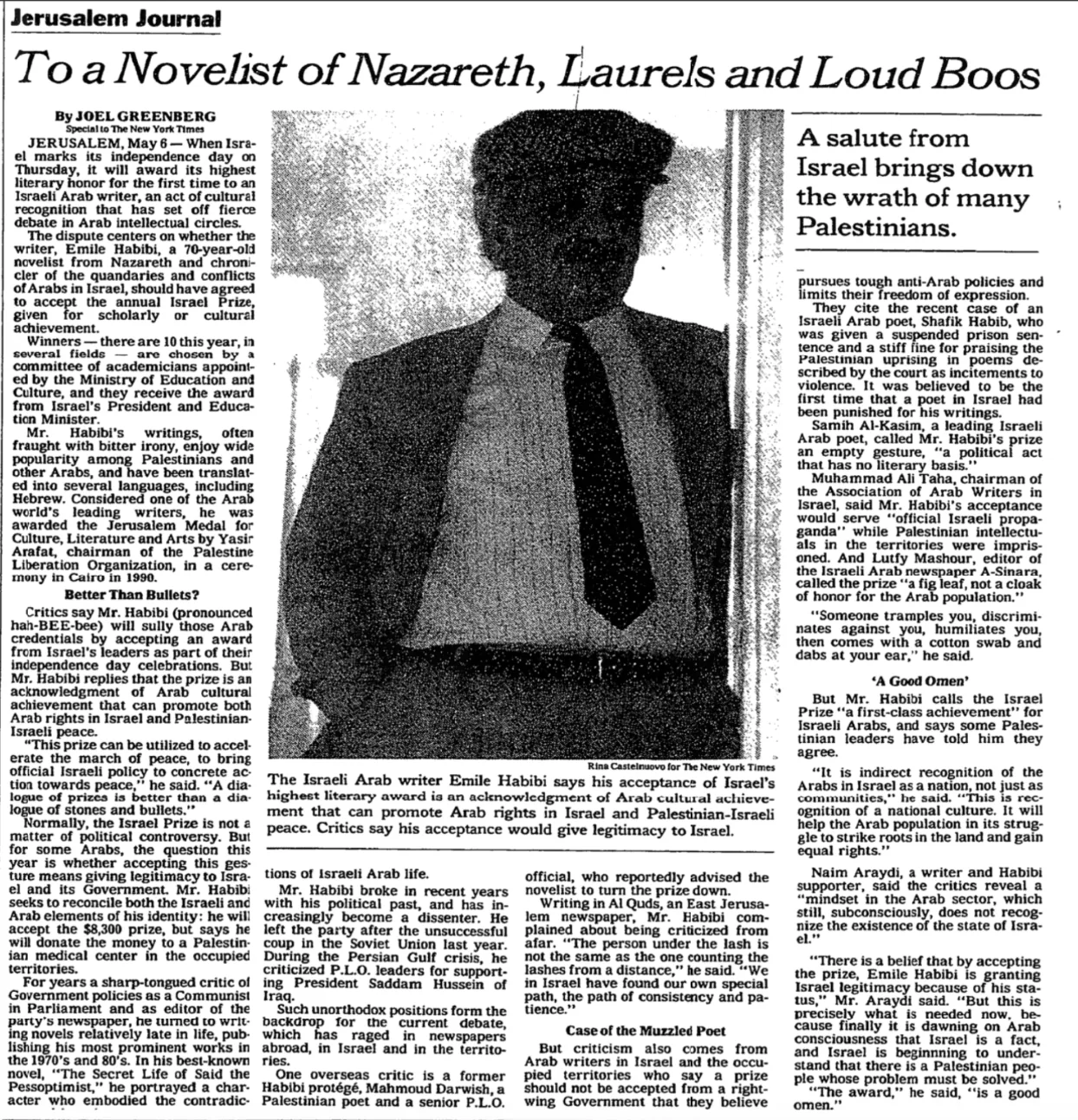
Transcribed from the clipping
JERUSALEM, May 6 — When Israel marks its independence day on Thursday, it will award its highest literary honor for the first time to an Israeli Arab writer, an act of cultural recognition that has set off fierce debate in Arab intellectual circles.
The dispute centers on whether the writer, Emile Habibi, a 70-year-old novelist from Nazareth and chronicler of the quandaries and conflicts of Arabs in Israel, should have agreed to accept the annual Israel Prize, given for scholarly or cultural achievement.
Winners — there are 10 this year, in several fields — are chosen by a committee of academicians appointed by the Ministry of Education and Culture, and they receive the award from Israel’s President and Education Minister. Mr.
Habibi’s writings, often fraught with bitter irony, enjoy wide popularity among Palestinians and other Arabs, and have been translated into several languages, including Hebrew.
Considered one of the Arab world’s leading writers, he was awarded the Jerusalem Medal for Culture, Literature and Arts by Yasir Arafat, chairman of the Palestine Liberation Organization, in a ceremony in Cairo in 1990. Better Than Bullets? Critics say Mr.
Habibi (pronounced hah-BEE-bee) will sully those Arab credentials by accepting an award from Israel’s leaders as part of their independence day celebrations. But Mr. Habibi replies that the prize is an acknowledgment of Arab cultural achievement that can promote both Arab rights in Israel and Palestinian-Israeli peace.
“This prize can be utilized to accelerate the march of peace, to bring official Israeli policy to concrete action towards peace,” he said. “A dialogue of prizes is better than a dialogue of stones and bullets.” Normally, the Israel Prize is not a matter of political controversy.
But for some Arabs, the question this year is whether accepting this gesture means giving legitimacy to Israel and its Government. Mr. Habibi seeks to reconcile both the Israeli and Arab elements of his identity: he will accept the $8,300 prize, but says he will donate the money to a Palestinian medical center in the occupied territories.
For years a sharp-tongued critic of Government policies as a Communist in Parliament and as editor of the party’s newspaper, he turned to writing novels relatively late in life, publishing his most prominent works in the 1970’s and 80’s.
In his best-known novel, “The Secret Life of Said the Pessoptimist,” he portrayed a character who embodied the contradictions of Israeli Arab life. Mr. Habibi broke in recent years with his political past, and has increasingly become a dissenter. He left the party after the unsuccessful coup in the Soviet Union last year.
During the Persian Gulf crisis, he criticized P.L.O. leaders for supporting President Saddam Hussein of Iraq. Such unorthodox positions form the backdrop for the current debate, which has raged in newspapers abroad, in Israel and in the territories.
One overseas critic is a former Habibi protégé, Mahmoud Darwish, a Palestinian poet and a senior P.L.O. official, who reportedly advised the novelist to turn the prize down. Writing in Al Quds, an East Jerusalem newspaper, Mr. Habibi complained about being criticized from afar.
“The person under the lash is not the same as the one counting the lashes from a distance,” he said. “We in Israel have found our own special path, the path of consistency and patience.”
Case of the Muzzled Poet But criticism also comes from Arab writers in Israel and the occupied territories who say a prize should not be accepted from a right-wing Government that they believe pursues tough anti-Arab policies and limits their freedom of expression.
They cite the recent case of an Israeli Arab poet, Shafik Habib, who was given a suspended prison sentence and a stiff fine for praising the Palestinian uprising in poems described by the court as incitements to violence. It was believed to be the first time that a poet in Israel had been punished for his writings. Samih Al-Kasim, a leading Israeli Arab poet, called Mr.
Habibi’s prize an empty gesture, “a political act that has no literary basis.” Muhammad Ali Taha, chairman of the Association of Arab Writers in Israel, said Mr. Habibi’s acceptance would serve “official Israeli propaganda” while Palestinian intellectuals in the territories were imprisoned.
And Lutfy Mashour, editor of the Israeli Arab newspaper A-Sinara, called the prize “a fig leaf, not a cloak of honor for the Arab population.” “Someone tramples you, discriminates against you, humiliates you, then comes with a cotton swab and dabs at your ear,” he said. ‘A Good Omen’ But Mr.
Habibi calls the Israel Prize “a first-class achievement” for Israeli Arabs, and says some Palestinian leaders have told him they agree. “It is indirect recognition of the Arabs in Israel as a nation, not just as communities,” he said. “This is recognition of a national culture.
It will help the Arab population in its struggle to strike roots in the land and gain equal rights.” Naim Arraydi, a writer and Habibi supporter, said the critics reveal a “mindset in the Arab sector, which still, subconsciously, does not recognize the existence of the state of Israel.”
“There is a belief that by accepting the prize, Emile Habibi is granting Israel legitimacy because of his status,” Mr. Arraydi said. “But this is precisely what is needed now, because finally it is dawning on Arab consciousness that Israel is a fact, and Israel is beginnning to understand that there is a Palestinian people whose problem must be solved.”
“The award,” he said, “is a good omen.”
Cite this clipping
"To a Novelist of Nazareth, Laurels and Loud Boos," The New York Times, 7 May 1992. Covering Palestine archive, CP-1992-022. https://coveringpalestine.org/archive/cp-1992-022
More from The New York Times
- The Maine Colony in PalestineThe New York Times · 12 November 1866
- Jewish Colonization in PalestineThe New York Times · 9 December 1883
- Jewish State in Palestine OpposedThe New York Times · 9 July 1897
- ZIONIST CONGRESS IN BASELThe New York Times · 31 August 1897
- ROME FEARS THE ZIONISTSThe New York Times · 12 September 1897
- PROGRESS OF ZIONISMThe New York Times · 16 December 1901
- 852 more from this paper in the full text →
More from the 1990s
- Is Zionism racism? YesFort Worth Star-Telegram · 4 January 1992
- Repealed / PendingThe Bay City Times · 13 January 1992
- Editorial was inaccurateIowa City Press-Citizen · 31 January 1992
- Arab terrorist might be sent to AlgiersThe Oregonian · 1 February 1992
- Palestinian terrorist leaves FranceSan Antonio Light · 2 February 1992
- 3 Israeli soldiers slain in attackDickinson Press · 16 February 1992
- All 374 clippings from the 1990s →
Last updated 2 November 2026
This record is part of Covering Palestine, an archive of American newspaper clippings about Palestinians, 1724 to 2023. Researched and assembled by Maria Robles.
The clipping belongs to the newspaper that printed it, or to the news agency that supplied the copy. It is reproduced here for research, criticism and commentary. A city here is where the newspaper was published, not where the story came from, and on most records it was taken from the masthead.
Something wrong here, or something you know about this clipping? The archive is still being built and corrections are wanted: maria@rozumstudio.com, quoting CP-1992-022.
Everything printed in 1992 · Printed on this day · See it in the archive reel · Full text of every clipping · Dataset