Newsday · Melville, New York · 19 September 1993
CP-1993-023
Rabin, Arafat: Joined by Their Fear of Zealots
Leslie Susser, diplomatic correspondent of The Jerusalem Report
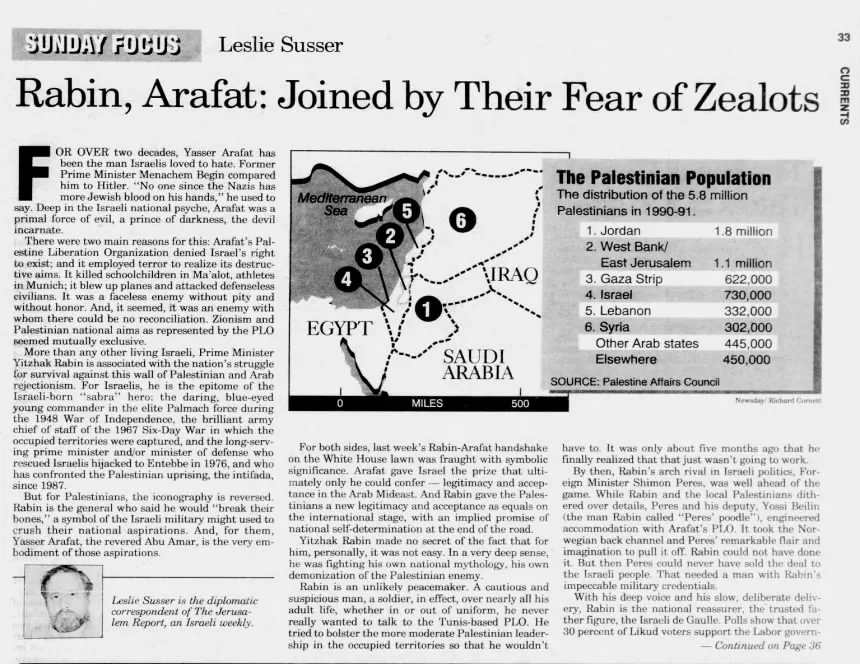
Transcribed from the clipping
FOR OVER two decades, Yasser Arafat has been the man Israelis loved to hate. Former Prime Minister Menachem Begin compared him to Hitler. “No one since the Nazis has more Jewish blood on his hands,” he used to say. Deep in the Israeli national psyche, Arafat was a primal force of evil, a prince of darkness, the devil incarnate.
There were two main reasons for this: Arafat’s Palestine Liberation Organization denied Israel’s right to exist; and it employed terror to realize its destructive aims. It killed schoolchildren in Ma’alot, athletes in Munich; it blew up planes and attacked defenseless civilians. It was a faceless enemy without pity and without honor.
And, it seemed, it was an enemy with whom there could be no reconciliation. Zionism and Palestinian national aims as represented by the PLO seemed mutually exclusive. More than any other living Israeli, Prime Minister Yitzhak Rabin is associated with the nation’s struggle for survival against this wall of Palestinian and Arab rejectionism.
For Israelis, he is the epitome of the Israeli-born “sabra” hero: the daring, blue-eyed young commander in the elite Palmach force during the 1948 War of Independence, the brilliant army chief of staff of the 1967 Six-Day War in which the occupied territories were captured, and the long-serving prime minister and/or minister of defense who rescued Israelis hijacked to Entebbe in 1976, and who has confronted the Palestinian uprising, the intifada, since 1987.
But for Palestinians, the iconography is reversed. Rabin is the general who said he would “break their bones,” a symbol of the Israeli military might used to crush their national aspirations. And, for them, Yasser Arafat, the revered Abu Amar, is the very embodiment of those aspirations.
For both sides, last week’s Rabin-Arafat handshake on the White House lawn was fraught with symbolic significance. Arafat gave Israel the prize that ultimately only he could confer — legitimacy and acceptance in the Arab Mideast.
And Rabin gave the Palestinians a new legitimacy and acceptance as equals on the international stage, with an implied promise of national self-determination at the end of the road. Yitzhak Rabin made no secret of the fact that for him, personally, it was not easy. In a very deep sense, he was fighting his own national mythology, his own demonization of the Palestinian enemy.
Rabin is an unlikely peacemaker. A cautious and suspicious man, a soldier, in effect, over nearly all his adult life, whether in or out of uniform, he never really wanted to talk to the Tunis-based PLO. He tried to bolster the more moderate Palestinian leadership in the occupied territories so that he wouldn’t have to.
It was only about five months ago that he finally realized that that just wasn’t going to work. By then, Rabin’s arch rival in Israeli politics, Foreign Minister Shimon Peres, was well ahead of the game.
While Rabin and the local Palestinians dithered over details, Peres and his deputy, Yossi Beilin (the man Rabin called “Peres’ poodle”), engineered accommodation with Arafat’s PLO. It took the Norwegian back channel and Peres’ remarkable flair and imagination to pull it off. Rabin could not have done it.
But then Peres could never have sold the deal to the Israeli people. That needed a man with Rabin’s impeccable military credentials. With his deep voice and his slow, deliberate delivery, Rabin is the national reassurer, the trusted father figure, the Israeli de Gaulle.
How this transcription was made
Transcribed by optical character recognition and read back against the scan by hand.
Cite this clipping
"Rabin, Arafat: Joined by Their Fear of Zealots," Newsday, 19 September 1993, p. 33. Covering Palestine archive, CP-1993-023. https://coveringpalestine.org/archive/cp-1993-023
More from Newsday
- Bare Slaying by Error of 48 Israeli ArabsNewsday · 13 December 1956
- Jordan Refugees Put at 200,000Newsday · 17 June 1967
- Not All Arabs Hate the JewsNewsday · 3 July 1967
- Arab women in the Jabalia refugee camp get their UN-supplied foodNewsday · 27 May 1973
- The Fragile Right to Be IsraelNewsday · 6 June 1977
- art review/Childhood reflectionsNewsday · 12 March 1982
- 11 more from this paper in the full text →
More from the 1990s
- Women in waitingThe Grand Rapids Press · 7 January 1993
- Status of Palestinian women is changing ever so slowlyThe Jonesboro Sun · 10 January 1993
- Careful sips of freedomThe Journal Times · 23 January 1993
- Situation of Palestinian women slowly changingDaily Chronicle · 24 January 1993
- Rabin defends plan to return PalestiniansThe Daily Press · 4 February 1993
- Israeli soldiers raid wedding partyThe Journal Star · 13 February 1993
- All 383 clippings from the 1990s →
Last updated 17 November 2026
This record is part of Covering Palestine, an archive of American newspaper clippings about Palestinians, 1724 to 2023. Researched and assembled by Maria Robles.
The clipping belongs to the newspaper that printed it, or to the news agency that supplied the copy. It is reproduced here for research, criticism and commentary. A city here is where the newspaper was published, not where the story came from, and on most records it was taken from the masthead.
Something wrong here, or something you know about this clipping? The archive is still being built and corrections are wanted: maria@rozumstudio.com, quoting CP-1993-023.
Everything printed in 1993 · Printed on this day · See it in the archive reel · Full text of every clipping · Dataset