The New York Times · 15 September 1993
CP-1993-043
Dividing a Homeland
Can the Israelis and Palestinians Work Out A Way to Share Space They Fought Over?
By THOMAS L. FRIEDMAN / Special to The New York Times
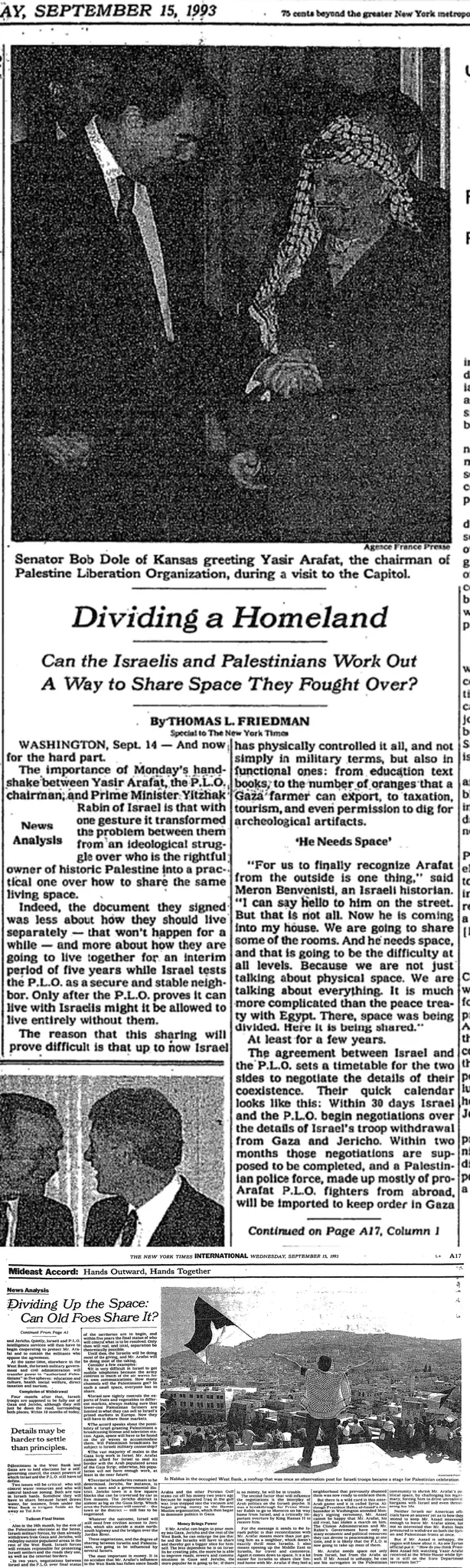
Shown from the top. The whole column — 3.3 times taller than it is wide — is in the enlargement.
Transcribed from the clipping
WASHINGTON, Sept. 14 — And now for the hard part.
The importance of Monday's handshake between Yasir Arafat, the P.L.O. chairman, and Prime Minister Yitzhak Rabin of Israel is that with one gesture it transformed the problem between them from an ideological struggle over who is the rightful owner of historic Palestine into a practical one over how to share the same living space.
Indeed, the document they signed was less about how they should live separately — that won't happen for a while — and more about how they are going to live together for an interim period of five years while Israel tests the P.L.O. as a secure and stable neighbor. Only after the P.L.O. proves it can live with Israelis might it be allowed to live entirely without them.
The reason that this sharing will prove difficult is that up to now Israel has physically controlled it all, and not simply in military terms, but also in functional ones: from education text books, to the number of oranges that a Gaza farmer can export, to taxation, tourism, and even permission to dig for archeological artifacts.
‘He Needs Space’ “For us to finally recognize Arafat from the outside is one thing,” said Meron Benvenisti, an Israeli historian. “I can say hello to him on the street. But that is not all. Now he is coming into my house. We are going to share some of the rooms. And he needs space, and that is going to be the difficulty at all levels.
Because we are not just talking about physical space. We are talking about everything. It is much more complicated than the peace treaty with Egypt. There, space was being divided. Here it is being shared.” At least for a few years. The agreement between Israel and the P.L.O. sets a timetable for the two sides to negotiate the details of their coexistence.
Their quick calendar looks like this: Within 30 days Israel and the P.L.O. begin negotiations over the details of Israel's troop withdrawal from Gaza and Jericho. Within two months those negotiations are supposed to be completed, and a Palestinian police force, made up mostly of pro-Arafat P.L.O. fighters from abroad, will be imported to keep order in Gaza and Jericho.
Quietly, Israeli and P.L.O. intelligence services will then have to begin cooperating to protect Mr. Arafat and to contain the militants who oppose the agreement.
At the same time, elsewhere in the West Bank, the Israeli military government and civil administration will transfer power to “authorized Palestinians” in five spheres: education and culture, health, social welfare, direct taxation and tourism.
Completion of Withdrawal Four months after that, Israeli troops are supposed to be fully out of Gaza and Jericho, although they will just be down the road, surrounding both places. Within 10 months of today, Palestinians in the West Bank and Gaza are to hold elections for a self-governing council, the exact powers of which Israel and the P.L.O. still have to define.
Two issues will be critical: who will control water resources and who will control land-use zoning. Both are now in Israeli hands. Somehow they will have to share, because Israel draws water, for instance, from under the West Bank to irrigate fields as far away as Tel Aviv.
Talkson Final Status Also in the 10th month, by the eve of the Palestinian elections at the latest, Israeli military forces, by then already withdrawn from Gaza and Jericho, will redeploy outside populated areas in the rest of the West Bank. Israeli forces will remain responsible for protecting Israeli settlers and the roads they use, as well as the external borders.
In two years, negotiations between Israel and the P.L.O. over final status of the territories are to begin, and within five years the final status of who will control what is to be resolved. Only then will real, and total, separation be theoretically possible. Until then, the Israelis will be doing most of the giving, and Mr. Arafat will be doing most of the taking.
Consider a few examples: ¶It is very difficult in Israel to get mobile telephones because the army controls so much of the air waves for its own communications. How many channels will the Palestinians get?
In such a small space, everyone has to share. ¶Israel now tightly controls the exports of fruits and vegetables to different markets, always making sure that lower-cost Palestinian farmers are limited in what they can sell to Israel's prized markets in Europe.
Now they will have to share those markets. ¶The accord speaks about the possibility of Israel granting Palestinians a broadcasting license and television station. Again, space will have to be found on the air waves to accommodate them. Will Palestinian broadcasts be subject to Israeli military censorship? ¶The vast majority of males in the Gaza Strip work in Israel. Mr.
Arafat cannot afford for Israel to seal its border with the Arab populated areas of the Gaza Strip; otherwise, his population will not have enough work, at least in the near future. ¶Territorial boundaries remain to be determined. Jericho, for instance, is both a town and a governmental district. Jericho town is a few square blocks that can be traversed by car in five minutes.
The Jericho district is almost as big as the Gaza Strip. Which area the Palestinians will control — the town or the district — still has to be negotiated. Whatever the outcome, Israel will still need free civilian access to Jericho, which sits astride a main north-south highway and the bridges over the Jordan River.
These negotiations, and the degree of sharing between Israelis and Palestinians, are going to be influenced by several factors. The most important is money. It is no accident that Mr. Arafat's influence in the West Bank has fallen since Saudi Arabia and the other Persian Gulf states cut off his money two years ago because he supported Iraq in the gulf war.
Iran stepped into the vacuum and began giving money to the Hamas Muslim organization, which then began to dominate politics in Gaza. Money Brings Power If Mr. Arafat can begin to pour money into Gaza, Jericho and the rest of the West Bank, he can enlarge the pie that he and the Israelis will have to share and thereby get a bigger slice for himself.
The less dependent he is on Israelis for creating jobs, the more he is able to improve roads, sewers and communications in Gaza and Jericho, the more popular he is going to be; if there is no money, he will be in trouble. The second factor that will influence the negotiations is the interplay of Arab politics on the Israeli psyche.
It was a breakthrough for Prime Minister Rabin to go to Morocco on his way home from Israel, and a critically important overture by King Hassan II to receive him. For the message it sends to the Israeli public is that reconciliation with Mr. Arafat means more than just getting him as a neighbor, which doesn't exactly thrill most Israelis.
It also means opening up the Middle East to Israelis, for travel and commerce. Again it comes down to space. It is a lot easier for Israelis to share their limited home with Mr. Arafat if they feel a neighborhood that previously shunned them was now ready to embrace them. But there is a wild card in this inter-Arab game and it is called Syria.
Although President Hafez al-Assad's Ambassador in Washington attended Monday's signing ceremony, Mr. Assad cannot be happy that Mr. Arafat, his old rival, has stolen a march on him. The Clinton Administration and Mr.
Rabin's Government have only so many economic and political resources they can devote to peacemaking at one time, and it is likely that the P.L.O. is now going to take up most of them. Mr. Arafat needs space not only from Israel, but from the Arabs as well. If Mr. Assad is unhappy, he can use his surrogates in the Palestinian community to shrink Mr.
Arafat's political space, by challenging his legitimacy, forcing him to drive unrealistic bargains with Israel and even threatening his life. Neither Israeli nor American officials have an answer yet as to how they intend to keep Mr. Assad interested enough to leave Mr. Arafat alone, but not so interested that Mr.
Rabin feels pressured to withdraw on both the Syrian and Palestinian fronts at once. But if Mr. Assad is unhappy, the region will know about it. As one Syrian official put it: “How do you think President Assad felt watching Yasir Arafat received at the White House while Syria is still on the State Department terrorism list?”
How this transcription was made
Record assembled from 2 scans: the front page (s063_1.jpg) and the A17 jump (s063_2.jpg), joined at “to keep order in Gaza / and Jericho.” Transcribed from 5–18x crops of every column on both scans. — Jump-page running head reads “THE NEW YORK TIMES INTERNATIONAL WEDNESDAY, SEPTEMBER 15, 1993 L+ A17.” The front-page scan's running head is cut at the left and shows “AY, SEPTEMBER 15, 1993 75 cents beyond the greater New York metropo[litan area].” Both agree with Maria's label. Again the masthead carries the definite article where her label does not. — Two, both verified at magnification and kept as set: the crosshead in column 1 of the jump is set “Talkson Final Status” with no space (verified at 18x); and the front-page photo caption reads “the chairman of Palestine Liberation Organization” with the article missing before “Palestine.” Also as printed: “archeological,” “air waves” as two words. — Two clippings of one article, joined into a single image for the record (s063_1.png, s063_2.png).
Cite this clipping
"Dividing a Homeland," The New York Times, 15 September 1993, p. 1 (front page), jump to A17, Column 1. Covering Palestine archive, CP-1993-043. https://coveringpalestine.org/archive/cp-1993-043
More from The New York Times
- The Maine Colony in PalestineThe New York Times · 12 November 1866
- Jewish Colonization in PalestineThe New York Times · 9 December 1883
- Jewish State in Palestine OpposedThe New York Times · 9 July 1897
- ZIONIST CONGRESS IN BASELThe New York Times · 31 August 1897
- ROME FEARS THE ZIONISTSThe New York Times · 12 September 1897
- PROGRESS OF ZIONISMThe New York Times · 16 December 1901
- 852 more from this paper in the full text →
More from the 1990s
- Women in waitingThe Grand Rapids Press · 7 January 1993
- Status of Palestinian women is changing ever so slowlyThe Jonesboro Sun · 10 January 1993
- Careful sips of freedomThe Journal Times · 23 January 1993
- Situation of Palestinian women slowly changingDaily Chronicle · 24 January 1993
- Rabin defends plan to return PalestiniansThe Daily Press · 4 February 1993
- Israeli soldiers raid wedding partyThe Journal Star · 13 February 1993
- All 374 clippings from the 1990s →
Last updated 2 November 2026
This record is part of Covering Palestine, an archive of American newspaper clippings about Palestinians, 1724 to 2023. Researched and assembled by Maria Robles.
The clipping belongs to the newspaper that printed it, or to the news agency that supplied the copy. It is reproduced here for research, criticism and commentary. A city here is where the newspaper was published, not where the story came from, and on most records it was taken from the masthead.
Something wrong here, or something you know about this clipping? The archive is still being built and corrections are wanted: maria@rozumstudio.com, quoting CP-1993-043.
Everything printed in 1993 · Printed on this day · See it in the archive reel · Full text of every clipping · Dataset