The Plain Dealer · Cleveland, OH · 14 September 2003
CP-2003-031
Palestinian arrivals hold onto heritage
Transcribed from the clipping
This gives Greater Cleveland one of the largest Palestinian communities in America. It is largely a first-generation immigrant community, often working-class couples struggling to send their kids to college. The community does not yet enjoy the resources to package its culture in museums or festivals for others to see.
Yet Palestinians display abundant culture going about their daily lives. Freshly butchered lambs hang from meat hooks above the shop floor at Al-Manar Market, and the butcher needs only reach up and pull down a carcass to begin his work at a whirring saw.
On a recent morning, store owner Mahmoud Zayid stood nearby and read aloud in Arabic notes he had scribbled on a piece of yellow notebook paper. A customer had called with specific instructions for cutting her meat. Zayid, his bushy black mustache twitching, watched as his butcher sliced lamb steaks thick as bricks.
He does a brisk business selling imported foods from the Middle East, wood-fired breads and lamb dinners to-go. But he’s most proud of the meats he butchers in accordance with Islamic halal standards, which are similar to kosher guidelines. A native of Jerusalem, Zayid moved his family from Chicago to Cleveland 10 years ago after visiting the city.
He said he liked Cleveland’s proximity to the countryside. Two years ago, he fulfilled his dream of opening a grocery store with a butcher shop. He buys lambs and goats directly from farms, he said, follows them to the slaughterhouse and cuts meats on demand. Customers have rewarded him with increasing business.
“I like Cleveland,” said Zayid, who lives with his wife and six children on the city’s West Side. “It’s quiet. I’m making it.” Palestinian families live scattered throughout western Cuyahoga County, in suburbs including Westlake, North Olmsted and especially Lakewood. But the largest concentration lives within walking distance of Al-Manar Market.
Up and down Lorain Avenue, between West Boulevard and West 130th Street, signs in Arabic news in Arabic. Palestinian women, like other Muslim women, are more likely to gather in each other’s homes. “We can’t have a coffee and go laugh loud in front of men, or take our scarf off,” said Nahida Farunia, who started an Arab American women’s club in Lakewood.
She was often lonely after moving to Cleveland 17 years ago. Not anymore. “You have a lot of Palestinian people from everywhere,” she said. Three Palestinian-owned supermarkets stand near West 117th Street and Lorain Avenue, and customers often greet one another with “al salam elikom,” peace be to you.
How this transcription was made
Date confirmed on the page (folio-verified (the folio reads “L2 | Sunday Life” at the left and “The Plain Dealer | Sunday, September 14, 2003” at the right. 14 September 2003 was a Sunday. Paper and date both). Adjudicated confirmed against the printed page: Folio across the top of the page: 'L2 | Sunday Life' at the left, 'The Plain Dealer | Sunday, September 14, 2003' at the right. 14 September 2003 was a Sunday. Spelling matches the archive's existing . Legibility fair; any passage that could not be read is omitted rather than reconstructed.
Context added by this archive
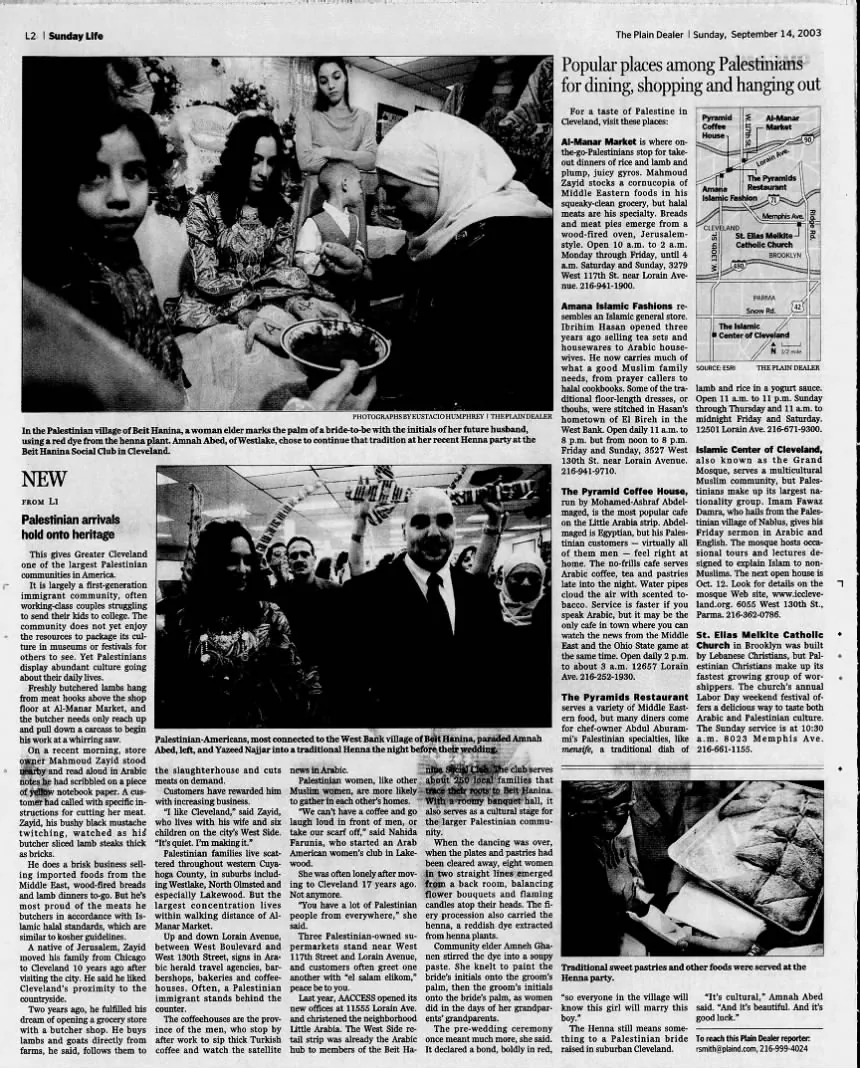
Photo credit: “PHOTOGRAPHS BY EUSTACIO HUMPHREY | THE PLAIN DEALER”. Caption 1: “In the Palestinian village of Beit Hanina, a woman elder marks the palm of a bride-to-be with the initials of her future husband, using a red dye from the henna plant. Amnah Abed, of Westlake, chose to continue that tradition at her recent Henna party at the Beit Hanina Social Club in Cleveland.”
Caption 2: “Palestinian-Americans, most connected to the West Bank village of Beit Hanina, paraded Amnah Abed, left, and Yazeed Najjar into a traditional Henna the night before their wedding.” Caption 3: “Traditional sweet pastries and other foods were served at the Henna party.”
This is the clipping to put beside the Los Angeles Times and Washington Post pair: same people, different continent, and the vocabulary stops wobbling the moment they are not being counted against Israelis.
Cite this clipping
"Palestinian arrivals hold onto heritage," The Plain Dealer, 14 September 2003, p. L2. Covering Palestine archive, CP-2003-031. https://coveringpalestine.org/archive/cp-2003-031
More from The Plain Dealer
- Arab Women Protest.The Plain Dealer · 28 October 1929
- Rabbi ‘Warns’ U.S. Jews About FundThe Plain Dealer · 23 October 1963
- Israel Integrating Druze AreasThe Plain Dealer · 1969
- Israel bars hunger strike by Arab mayors in GazaThe Plain Dealer · 18 November 1979
- Jordan no Palestine state, Hussein saysThe Plain Dealer · 3 August 1982
- Israeli says he attacked Palestinians for revengeThe Plain Dealer · 5 November 1984
- 9 more from this paper in the full text →
More from the 2000s
- Unfortunately, It Was ParadiseSan Francisco Chronicle · 19 January 2003
- 62 Palestinian shops destroyedColumbia Missourian · 22 January 2003
- Israeli forces kill two PalestiniansThe Charlotte Observer · 30 January 2003
- A Palestinian boy holds a bomb used by Israeli soldiers as he stands in the rubble of his family home Monday in Jabalia in GazaThe Gazette · 1 February 2003
- Some Israelis contemplate low-grade ‘genocide’ for PalestiniansThe Free Lance-Star · 2 February 2003
- Two Palestinian farmers killed by Israeli fireIndex-Journal · 4 February 2003
- All 516 clippings from the 2000s →
Last updated 2 November 2026
This record is part of Covering Palestine, an archive of American newspaper clippings about Palestinians, 1724 to 2023. Researched and assembled by Maria Robles.
The clipping belongs to the newspaper that printed it, or to the news agency that supplied the copy. It is reproduced here for research, criticism and commentary. A city here is where the newspaper was published, not where the story came from, and on most records it was taken from the masthead.
Something wrong here, or something you know about this clipping? The archive is still being built and corrections are wanted: maria@rozumstudio.com, quoting CP-2003-031.
Everything printed in 2003 · Printed on this day · See it in the archive reel · Full text of every clipping · Dataset