San Francisco Chronicle · San Francisco, California · 11 August 2008
CP-2008-011
Mahmoud Darwish — poet, Palestinian cultural icon
Obituary
Diaa Hadid, Associated Press, Gaza City
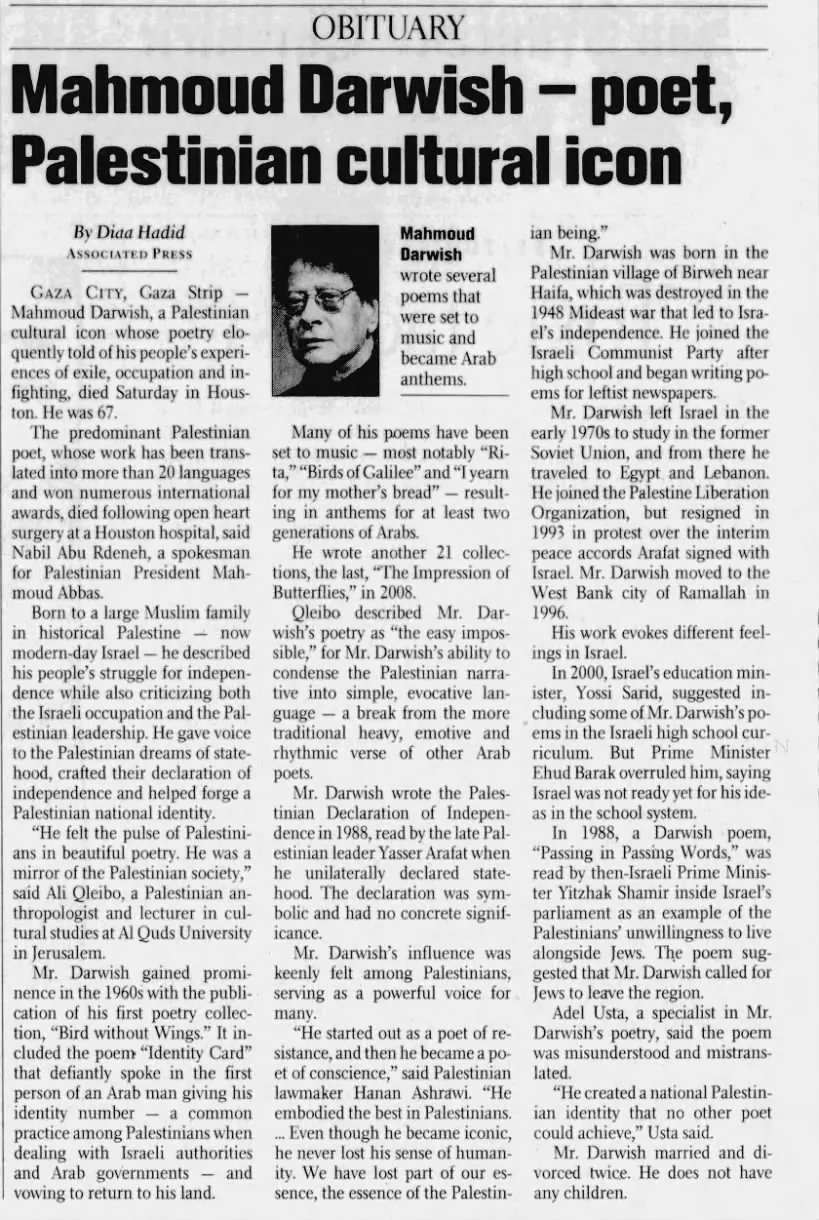
Transcribed from the clipping
“GAZA CITY, Gaza Strip — Mahmoud Darwish, a Palestinian cultural icon whose poetry eloquently told of his people’s experiences of exile, occupation and infighting, died Saturday in Houston. He was 67… Born to a large Muslim family in historical Palestine — now modern-day Israel — he described his people’s struggle for independence while also criticizing both the Israeli occupation and the Palestinian leadership. He gave voice to the Palestinian dreams of statehood, crafted their declaration of independence and helped forge a Palestinian national identity.… Mr. Darwish gained prominence in the 1960s with the publication of his first poetry collection, ‘Bird without Wings.’ It included the poem ‘Identity Card’ that defiantly spoke in the first person of an Arab man giving his identity number — a common practice among Palestinians when dealing with Israeli authorities and Arab governments — and vowing to return to his land. Many of his poems have been set to music — most notably ‘Rita,’ ‘Birds of Galilee’ and ‘I yearn for my mother’s bread’ — resulting in anthems for at least two generations of Arabs.… Qleibo described Mr. Darwish’s poetry as ‘the easy impossible,’ for Mr. Darwish’s ability to condense the Palestinian narrative into simple, evocative language… Mr. Darwish was born in the Palestinian village of Birweh near Haifa, which was destroyed in the 1948 Mideast war that led to Israel’s independence.… In 1988, a Darwish poem, ‘Passing in Passing Words,’ was read by then-Israeli Prime Minister Yitzhak Shamir inside Israel’s parliament as an example of the Palestinians’ unwillingness to live alongside Jews. The poem suggested that Mr. Darwish called for Jews to leave the region. Adel Usta, a specialist in Mr. Darwish’s poetry, said the poem was misunderstood and mistranslated. ‘He created a national Palestinian identity that no other poet could achieve,’ Usta said. Mr. Darwish married and divorced twice. He does not have any children.”
Photograph caption
A portrait, with the pull quote: “Mahmoud Darwish wrote several poems that were set to music and became Arab anthems.”
Context added by this archive
The sixth American printing of this obituary held here, and the only one filed under a standing Obituary head rather than as news. That makes the two sets even: six printings of the death of Mahmoud Darwish, six headlines, every one of which calls him a poet or a cultural icon; and six printings of the killing of Ghassan Kanafani in 1972, of which one headline calls him an artist and the other five call him a leader, a chief, a militant, a guerrilla and a terrorist. One man was assassinated and one died after heart surgery, and both belonged to Palestinian political organisations, so this is a count and not an experiment.
Cite this item
"Mahmoud Darwish — poet, Palestinian cultural icon," San Francisco Chronicle, 11 August 2008. Covering Palestine archive, CP-2008-011. https://coveringpalestine.org/archive/cp-2008-011
Elsewhere in the archive
- Ex-ambassador calls Arafat obstructionistSan Francisco Chronicle · 23 April 2002 · the same newspaper
- Arab Protests Erupt in ViolenceSan Francisco Chronicle · 15 May 1998 · the same newspaper
- Palestinian aid; ‘Hannibal’ directiveSan Francisco Chronicle · 15 March 2018 · the same newspaper
- Food, not bombsColumbia Daily Tribune · 16 January 2008 · the same year
- Palestinians mourn Israel’s anniversary as the ‘Nakba’The Day · 16 May 2008 · the same year
- Remembering the Nakba on Israel’s 60th anniversaryWisconsin State Journal · 16 May 2008 · the same year
This record is part of Covering Palestine, an archive of American and Anglophone newspaper clippings about Palestinians, 1812 to 2022. Researched and assembled by Maria Robles.
The clipping belongs to the newspaper that printed it, or to the wire service that supplied the copy. It is reproduced here for research, criticism and commentary. The city is derived from the masthead, not read off the clipping.
Something wrong here, or something you know about this clipping? The archive is still being built and corrections are wanted: maria@rozumstudio.com, quoting CP-2008-011.
See it in the archive reel · Full text of every clipping · Dataset