Los Angeles Times · 12 July 2009
CP-2009-049
Across the great divide
They share a passion for the Middle East, where geography and the personal hold sway.
AMY WILENTZ
Transcribed from the clipping
I am a Jew, but also part Palestinian, and pretty much part Lebanese. My great-grandmother, a Jew, was born in northern Palestine and grew up in Beirut. Her first language was Arabic, her second French. By the rules defining who can be called an Arab, she was one: a child of the Arabic tongue. My great-grandfather too.
Another Jew, he was born in Safed and grew up in Alexandria; first language, Arabic. They married in Beirut. When they arrived at Ellis Island, in 1896, they were classified as Turks. By the time I was born, no one in my family talked about this. My first hint was the word my mother used for eggplant, which sounded like “battenjam.”
Thirty years later, I discovered in a book by Palestinian intellectual Edward Said that the Arabic word for eggplant was badinjan. It was as if I had suddenly dipped the madeleine in my tea: A world opened before me. Where my ancestors came from matters, because in the Middle East — which I love completely — everything is geographical.
In “A World I Loved: The Story of an Arab Woman” (Nation Books: 208 pp., $14.95 paper), Wadad Makdisi Cortas, born in 1909, manifests a similar love, inflamed yet tempered by loss. As I read her book, I kept thinking: This is my country too. And yet for Cortas, the greatest disaster was the founding of Israel — also, supposedly, my country.
Everything’s geographical in the Middle East, and personal too: I have a personal interest in Cortas. She is the mother of my longtime acquaintance Mariam Cortas Said and the mother-in-law of Mariam’s late husband, that same Edward Said. (The central figure in my novel about Jerusalem, “Martyrs’ Crossing,” is based in part on him.)
The Makdisis and Saids form an intermarried intellectual dynasty. Edward was one of the commanding Arab thinkers of our era. His sister, Jean Said Makdisi, wrote a stunning memoir of the Lebanese civil war called “Beirut Fragments.” Her son Saree, who teaches at UCLA, wrote “Palestine Inside Out: An Everyday Occupation.”
All were or are teachers or professors — educators at heart. Cortas is an emblematic figure of this family. One of the early educated women of the Arab world, she studied in the U.S. and Paris before returning to Beirut. There, she became a teacher, and then, for 40 years, headmistress of Beirut’s Ahliah School for Girls, where she had studied and taught.
How this transcription was made
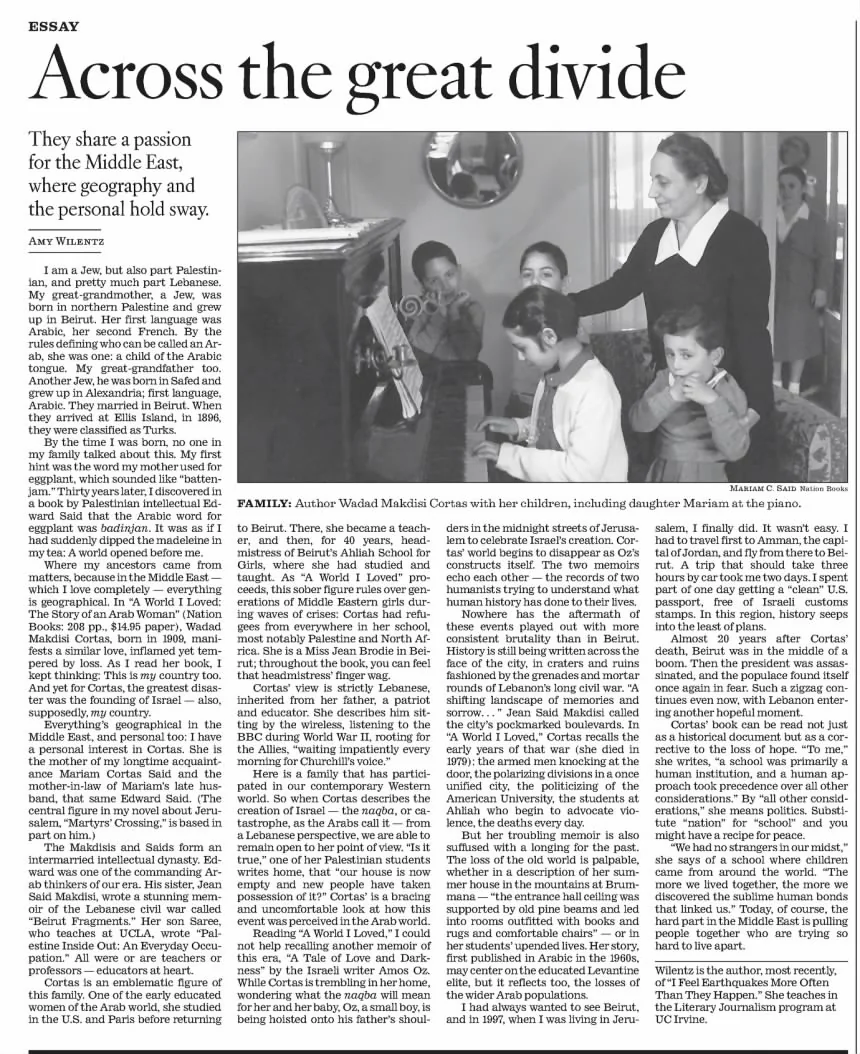
Read from the scan Maria supplied on 17 November 2026, at magnification, band by band. No masthead, no folio line and no date on this clipping; it is cropped to the essay package, with the standing label “ESSAY” at the top left and white space below the last column. So the label date 2009-07-12 cannot be confirmed from the page. Nothing on the page contradicts it either: the book under review, “A World I Loved: The Story of an Arab Woman”, is given as a Nation Books paperback at $14.95, which fits a 2009 review, and the newest event named is “Lebanon entering another hopeful moment”. There is no datable detail closer than that. LOS ANGELES AND TWO SOUTHERN CALIFORNIA CAMPUSES. Quoting the page: “Her son Saree, who teaches at UCLA, wrote ‘Palestine Inside Out: An Everyday Occupation.’” And the author’s tagline at the foot of the fourth column: “Wilentz is the author, most recently, of ‘I Feel Earthquakes More Often Than They Happen.’ She teaches in the Literary Journalism program at UC Irvine.” A third campus is named in the body, outside this excerpt: “the politicizing of the American University, the students at Ahliah who begin to advocate violence”. For the Consortium search this is the richest single page in the deck — a Los Angeles paper, a UCLA professor, a UC Irvine professor, and a Palestinian intellectual dynasty, all on one page. FOURTH CLIPPING IN THIS DECK TO NAME SAREE MAKDISI OF UCLA (after la084’s campus protest, la089’s letters and la090/la091’s syndicated column). Here he appears not as a combatant in an argument but as a member of a family: “The Makdisis and Saids form an intermarried intellectual dynasty.” If the Consortium wants a through-line, it is already in these five clippings. AN ERROR THE PAPER PRINTED, LEFT AS SET. The Arabic word for the catastrophe of 1948 is set twice as “naqba”, in italic, in the second and third columns: “the creation of Israel — the naqba, or catastrophe, as the Arabs call it” and “wondering what the naqba will mean for her and her baby”. The usual transliteration is nakba. Transcribed as printed; I have corrected nothing. Flagging it because a vocabulary search of the archive for “nakba” will not find this page. “ESSAY”, set in small bold caps above the headline rule, is a standing label, not a deck and not part of the headline. The deck is the three-line serif line under the headline, “They share a passion for the Middle East, where geography and the personal hold sway.”, set above the byline rule; it is recorded in dek with its printed full stop. No masthead on this clipping, so I cannot check it against pub “Los Angeles Times”. The only clipping in this deck that shows the running head is la084, and it reads “LOS ANGELES TIMES” with no leading “The”, matching the archive. The deck caption here, “Los Angeles Times July 12 2009”, also omits the “The”; no disagreement to report. The photograph credit, set flush right above the caption in small caps, reads “MARIAM C. SAID Nation Books” — that is, the picture comes from the book, credited to the daughter who appears in it. The caption itself opens with a bold kicker word, “FAMILY:”, which I kept in photo_caption because it is set as part of the caption line. QUOTATIONS PRESENT ON THE PAGE BUT OUTSIDE THIS EXCERPT, so not in quotes[]. From Wadad Makdisi Cortas’s memoir, in the fourth column: “To me,” she writes, “a school was primarily a human institution, and a human approach took precedence over all other considerations.” And: “We had no strangers in our midst,” she says of a school where children came from around the world. “The more we lived together, the more we discovered the sublime human bonds that linked us.” In the second column, a Palestinian schoolgirl’s letter, quoted in two fragments rather than as a whole sentence: “Is it true,” one of her Palestinian students writes home, that “our house is now empty and new people have taken possession of it?” If the archive wants Cortas’s own words, the excerpt has to run to the foot of the fourth column. Wadad Makdisi Cortas is marked side p. The page calls the family Palestinian through Edward Said (“Palestinian intellectual Edward Said”) and the book is subtitled “The Story of an Arab Woman”; Cortas herself is described as Lebanese in outlook (“Cortas’ view is strictly Lebanese”). Flagging rather than deciding, because the page genuinely holds both. The $14.95 book price is printed with a dollar sign in the excerpt; kept as set.
Cite this clipping
"Across the great divide," Los Angeles Times, 12 July 2009. Covering Palestine archive, CP-2009-049. https://coveringpalestine.org/archive/cp-2009-049
More from Los Angeles Times
- The Palestinians’ EvolutionLos Angeles Times · 21 March 1969
- Bomb Victim Had Expected DeathLos Angeles Times · 10 July 1972
- Mrs. Meir's Safety StudiedLos Angeles Times · 11 January 1973
- Show of Artists from PalestineLos Angeles Times · 24 June 1977
- UCLA Jewish Groups Ask Palestinian BanLos Angeles Times · 21 October 1984
- UCLA Renews Rival Groups' StatusLos Angeles Times · 1 November 1984
- 60 more from this paper in the full text →
More from the 2000s
- Stop genocide in PalestineArgus Leader · 1 January 2009
- Re: Stop genocide in PalestineArgus Leader · 3 January 2009
- Israeli ground operation cuts Gaza Strip in twoThe Philadelphia Inquirer · 5 January 2009
- Israeli troops and tanks slice deep into GazaDayton Daily News · 5 January 2009
- CASUALTIES: A Palestinian man carries a girl killed in an Israeli strike into Shifa Hospital in Gaza City; a wounded Israeli soldier arrives at a hospital in BeershebaLos Angeles Times · 6 January 2009
- Israel killing people, hope and ambitionVentura County Star · 6 January 2009
- All 527 clippings from the 2000s →
Last updated 17 November 2026
This record is part of Covering Palestine, an archive of American newspaper clippings about Palestinians, 1724 to 2023. Researched and assembled by Maria Robles.
The clipping belongs to the newspaper that printed it, or to the news agency that supplied the copy. It is reproduced here for research, criticism and commentary. A city here is where the newspaper was published, not where the story came from, and on most records it was taken from the masthead.
Something wrong here, or something you know about this clipping? The archive is still being built and corrections are wanted: maria@rozumstudio.com, quoting CP-2009-049.
Everything printed in 2009 · Printed on this day · See it in the archive reel · Full text of every clipping · Dataset