The Journal News · White Plains, NY · 13 June 2021
CP-2021-026
Ultranationalist Naftali Bennett may lead Israel's new government
Joseph Krauss / ASSOCIATED PRESS
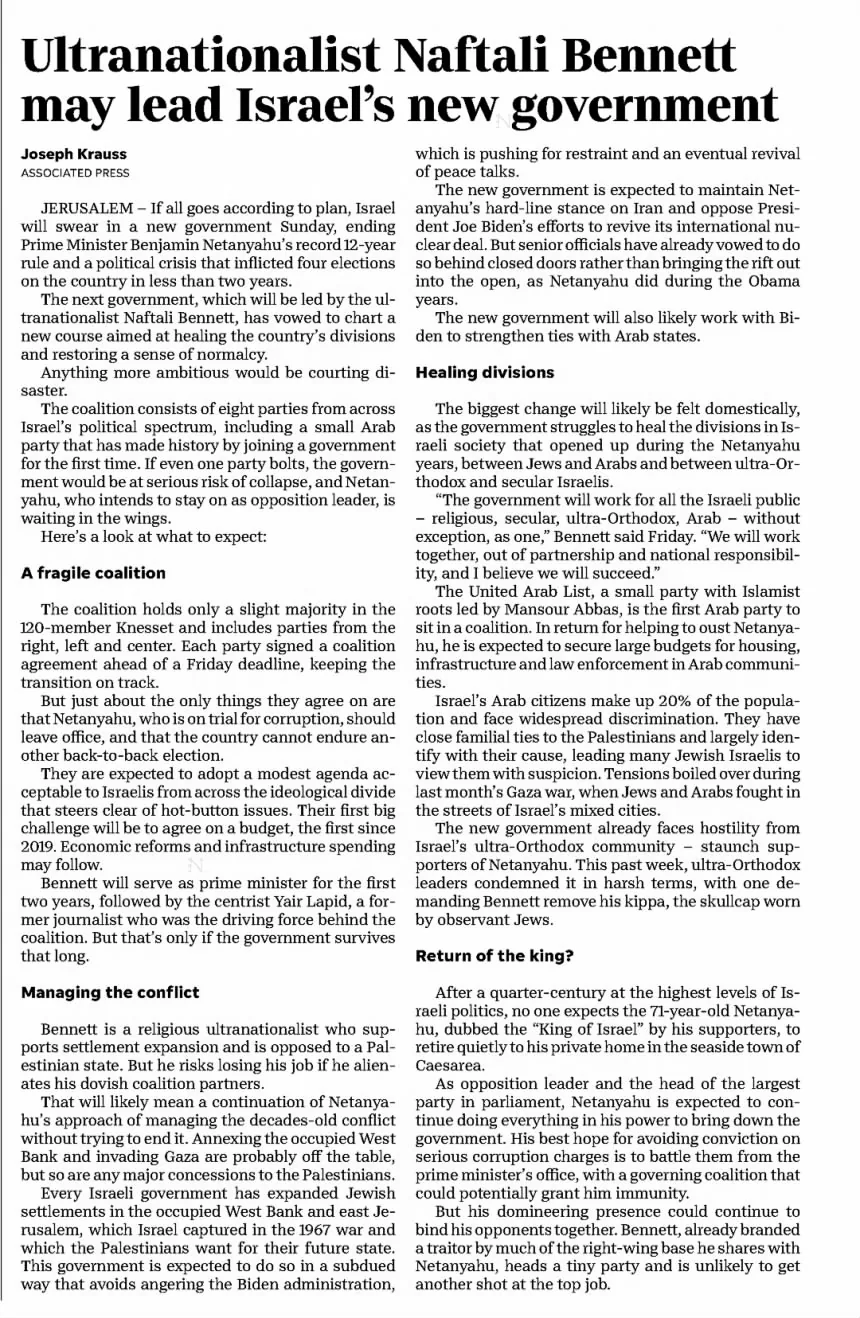
Transcribed from the clipping
JERUSALEM – If all goes according to plan, Israel will swear in a new government Sunday, ending Prime Minister Benjamin Netanyahu’s record 12-year rule and a political crisis that inflicted four elections on the country in less than two years.
The next government, which will be led by the ultranationalist Naftali Bennett, has vowed to chart a new course aimed at healing the country’s divisions and restoring a sense of normalcy. Anything more ambitious would be courting disaster.
The coalition consists of eight parties from across Israel’s political spectrum, including a small Arab party that has made history by joining a government for the first time. If even one party bolts, the government would be at serious risk of collapse, and Netanyahu, who intends to stay on as opposition leader, is waiting in the wings.
Here’s a look at what to expect: A fragile coalition The coalition holds only a slight majority in the 120-member Knesset and includes parties from the right, left and center. Each party signed a coalition agreement ahead of a Friday deadline, keeping the transition on track.
But just about the only things they agree on are that Netanyahu, who is on trial for corruption, should leave office, and that the country cannot endure another back-to-back election. They are expected to adopt a modest agenda acceptable to Israelis from across the ideological divide that steers clear of hot-button issues.
Their first big challenge will be to agree on a budget, the first since 2019. Economic reforms and infrastructure spending may follow. Bennett will serve as prime minister for the first two years, followed by the centrist Yair Lapid, a former journalist who was the driving force behind the coalition. But that’s only if the government survives that long.
Managing the conflict Bennett is a religious ultranationalist who supports settlement expansion and is opposed to a Palestinian state. But he risks losing his job if he alienates his dovish coalition partners. That will likely mean a continuation of Netanyahu’s approach of managing the decades-old conflict without trying to end it.
Annexing the occupied West Bank and invading Gaza are probably off the table, but so are any major concessions to the Palestinians. Every Israeli government has expanded Jewish settlements in the occupied West Bank and east Jerusalem, which Israel captured in the 1967 war and which the Palestinians want for their future state.
This government is expected to do so in a subdued way that avoids angering the Biden administration, which is pushing for restraint and an eventual revival of peace talks.
How this transcription was made
Date and publication rest on the collector's slide label; no masthead, folio or printed dateline appears on this clipping.
Context added by this archive
ONE OF ONLY THREE PLACES IN BATCH B where an American paper uses 'occupied' in its own voice, and the only wire story that does: 'Annexing the occupied West Bank', then 'Jewish settlements in the occupied West Bank and east Jerusalem' in the next paragraph.
The headline word is 'Ultranationalist', set in the headline rather than buried; the body repeats it twice ('the ultranationalist Naftali Bennett', 'a religious ultranationalist who supports settlement expansion and is opposed to a Palestinian state').
Compare the Citizens' Voice six months later (slide 37), where he is simply 'Israeli Prime Minister Naftali Bennett' and none of this appears. The AP also states, flatly, that Israel's Arab citizens 'face widespread discrimination' - a sentence that appears nowhere else in these twenty slides.
Cite this clipping
"Ultranationalist Naftali Bennett may lead Israel's new government," The Journal News, 13 June 2021. Covering Palestine archive, CP-2021-026. https://coveringpalestine.org/archive/cp-2021-026
More from The Journal News
- PLO move bodes well for peaceThe Journal News · 16 November 1988
- Journalist wounded by gunfire in Gaza StripThe Journal News · 16 December 1990
- Increased criticism of Israel justifiedThe Journal News · 20 April 2002
- Thousands at D.C. rally denounce Israeli, U.S. policiesThe Journal News · 21 April 2002
- The making of a human bombThe Journal News · 27 October 2005
- Palestinian women argue with security officers in RamallahThe Journal News · 8 March 2006
- 3 more from this paper in the full text →
More from the 2020s
- Joe and Bibi talked, but what's it mean? Biden and Israel, the scorecard.St. Louis Jewish Light · 24 February 2021
- Phoenix family shares recipe for rice dishThe Arizona Republic · 28 April 2021
- Cooking TogetherChicago Tribune · 7 May 2021
- Palestinians fear loss of homes as evictions loomThe Palm Beach Post · 11 May 2021
- Beset by virus, Gaza’s hospitals now struggle with woundedKentucky New Era · 15 May 2021
- Biden supports cease-fireDaily Citizen · 18 May 2021
- All 202 clippings from the 2020s →
Last updated 2 November 2026
This record is part of Covering Palestine, an archive of American newspaper clippings about Palestinians, 1724 to 2023. Researched and assembled by Maria Robles.
The clipping belongs to the newspaper that printed it, or to the news agency that supplied the copy. It is reproduced here for research, criticism and commentary. A city here is where the newspaper was published, not where the story came from, and on most records it was taken from the masthead.
Something wrong here, or something you know about this clipping? The archive is still being built and corrections are wanted: maria@rozumstudio.com, quoting CP-2021-026.
Everything printed in 2021 · Printed on this day · See it in the archive reel · Full text of every clipping · Dataset