The New York Times · 13 November 1975
CP-1975-027
Zionism and Racism
By A. M. El-Messiri
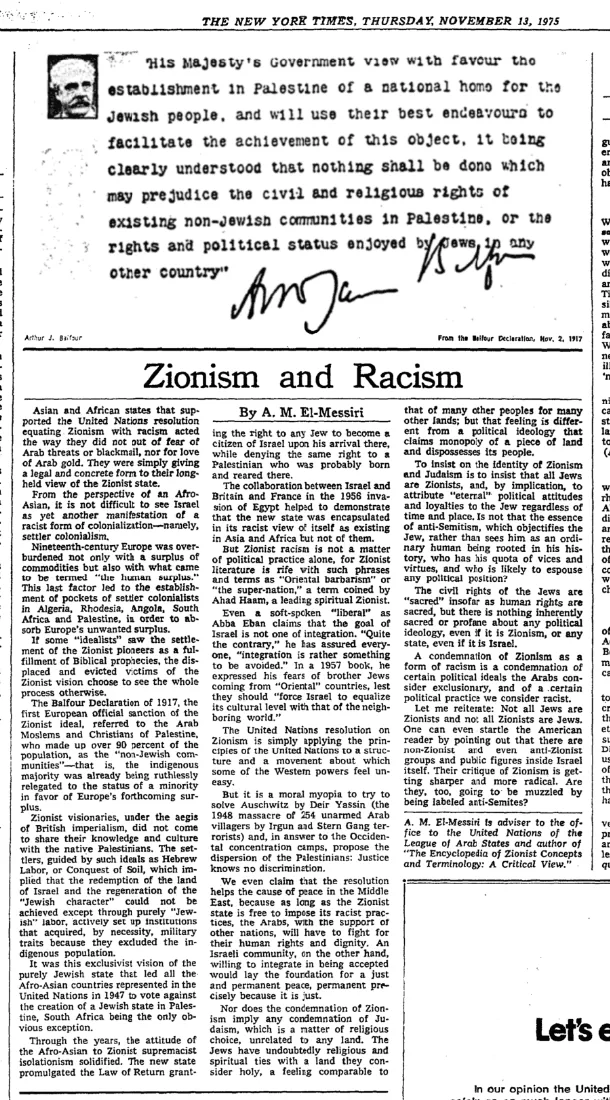
Transcribed from the clipping
Asian and African states that supported the United Nations resolution equating Zionism with racism acted the way they did not out of fear of Arab threats or blackmail, nor for love of Arab gold. They were simply giving a legal and concrete form to their long-held view of the Zionist state.
From the perspective of an Afro-Asian, it is not difficult to see Israel as yet another manifestation of a racist form of colonialization — namely, settler colonialism. Nineteenth-century Europe was overburdened not only with a surplus of commodities but also with what came to be termed “the human surplus.”
This last factor led to the establishment of pockets of settler colonialists in Algeria, Rhodesia, Angola, South Africa and Palestine, in order to absorb Europe’s unwanted surplus.
If some “idealists” saw the settlement of the Zionist pioneers as a fulfillment of Biblical prophecies, the displaced and evicted victims of the Zionist vision choose to see the whole process otherwise.
The Balfour Declaration of 1917, the first European official sanction of the Zionist ideal, referred to the Arab Moslems and Christians of Palestine, who made up over 90 percent of the population, as the “non-Jewish communities” — that is, the indigenous majority was already being ruthlessly relegated to the status of a minority in favor of Europe’s forthcoming surplus.
Zionist visionaries, under the aegis of British imperialism, did not come to share their knowledge and culture with the native Palestinians.
The settlers, guided by such ideals as Hebrew Labor, or Conquest of Soil, which implied that the redemption of the land of Israel and the regeneration of the “Jewish character” could not be achieved except through purely “Jewish” labor, actively set up institutions that acquired, by necessity, military traits because they excluded the indigenous population.
It was this exclusivist vision of the purely Jewish state that led all the Afro-Asian countries represented in the United Nations in 1947 to vote against the creation of a Jewish state in Palestine, South Africa being the only obvious exception. Through the years, the attitude of the Afro-Asian to Zionist supremacist isolationism solidified.
The new state promulgated the Law of Return granting the right to any Jew to become a citizen of Israel upon his arrival there, while denying the same right to a Palestinian who was probably born and reared there.
The collaboration between Israel and Britain and France in the 1956 invasion of Egypt helped to demonstrate that the new state was encapsulated in its racist view of itself as existing in Asia and Africa but not of them.
But Zionist racism is not a matter of political practice alone, for Zionist literature is rife with such phrases and terms as “Oriental barbarism” or “the super-nation,” a term coined by Ahad Haam, a leading spiritual Zionist. Even a soft-spoken “liberal” as Abba Eban claims that the goal of Israel is not one of integration.
“Quite the contrary,” he has assured everyone, “integration is rather something to be avoided.” In a 1957 book, he expressed his fears of brother Jews coming from “Oriental” countries, lest they should “force Israel to equalize its cultural level with that of the neighboring world.”
The United Nations resolution on Zionism is simply applying the principles of the United Nations to a structure and a movement about which some of the Western powers feel uneasy.
But it is a moral myopia to try to solve Auschwitz by Deir Yassin (the 1948 massacre of 254 unarmed Arab villagers by Irgun and Stern Gang terrorists) and, in answer to the Occidental concentration camps, propose the dispersion of the Palestinians: Justice knows no discrimination.
We even claim that the resolution helps the cause of peace in the Middle East, because as long as the Zionist state is free to impose its racist practices, the Arabs, with the support of other nations, will have to fight for their human rights and dignity.
An Israeli community, on the other hand, willing to integrate in being accepted would lay the foundation for a just and permanent peace, permanent precisely because it is just. Nor does the condemnation of Zionism imply any condemnation of Judaism, which is a matter of religious choice, unrelated to any land.
The Jews have undoubtedly religious and spiritual ties with a land they consider holy, a feeling comparable to that of many other peoples for many other lands; but that feeling is different from a political ideology that claims monopoly of a piece of land and dispossesses its people.
To insist on the identity of Zionism and Judaism is to insist that all Jews are Zionists, and, by implication, to attribute “eternal” political attitudes and loyalties to the Jew regardless of time and place.
Is not that the essence of anti-Semitism, which objectifies the Jew, rather than sees him as an ordinary human being rooted in his history, who has his quota of vices and virtues, and who is likely to espouse any political position?
The civil rights of the Jews are “sacred” insofar as human rights are sacred, but there is nothing inherently sacred or profane about any political ideology, even if it is Zionism, or any state, even if it is Israel.
A condemnation of Zionism as a form of racism is a condemnation of certain political ideals the Arabs consider exclusionary, and of a certain political practice we consider racist. Let me reiterate: Not all Jews are Zionists and not all Zionists are Jews.
One can even startle the American reader by pointing out that there are non-Zionist and even anti-Zionist groups and public figures inside Israel itself. Their critique of Zionism is getting sharper and more radical. Are they, too, going to be muzzled by being labeled anti-Semites?
Cite this clipping
"Zionism and Racism," The New York Times, 13 November 1975. Covering Palestine archive, CP-1975-027. https://coveringpalestine.org/archive/cp-1975-027
More from The New York Times
- The Maine Colony in PalestineThe New York Times · 12 November 1866
- Jewish Colonization in PalestineThe New York Times · 9 December 1883
- Jewish State in Palestine OpposedThe New York Times · 9 July 1897
- ZIONIST CONGRESS IN BASELThe New York Times · 31 August 1897
- ROME FEARS THE ZIONISTSThe New York Times · 12 September 1897
- PROGRESS OF ZIONISMThe New York Times · 16 December 1901
- 852 more from this paper in the full text →
More from the 1970s
- Israeli Prison Chief Denies Any Torture Of Arab PrisonersThe New York Times · 20 January 1975
- Palestinians Confident New State Will Be FormedNashua Telegraph · 5 February 1975
- Kissinger hopeful; Marxist Palestinian pledges warMidland Daily News · 11 February 1975
- Refugee art on display at SSC during MarchNews Chronicle · 4 March 1975
- Drawings on displayPublic Opinion · 10 March 1975
- U.N. Agency Deficit Is Said to Threaten Palestinian SchoolsThe New York Times · 15 June 1975
- All 338 clippings from the 1970s →
Last updated 2 November 2026
This record is part of Covering Palestine, an archive of American newspaper clippings about Palestinians, 1724 to 2023. Researched and assembled by Maria Robles.
The clipping belongs to the newspaper that printed it, or to the news agency that supplied the copy. It is reproduced here for research, criticism and commentary. A city here is where the newspaper was published, not where the story came from, and on most records it was taken from the masthead.
Something wrong here, or something you know about this clipping? The archive is still being built and corrections are wanted: maria@rozumstudio.com, quoting CP-1975-027.
Everything printed in 1975 · Printed on this day · See it in the archive reel · Full text of every clipping · Dataset