The Miami Herald · Miami, Florida · 18 May 2008
CP-2008-003
Israel-Palestinian coverage is a matter of perception
Miami Herald Ombudsman
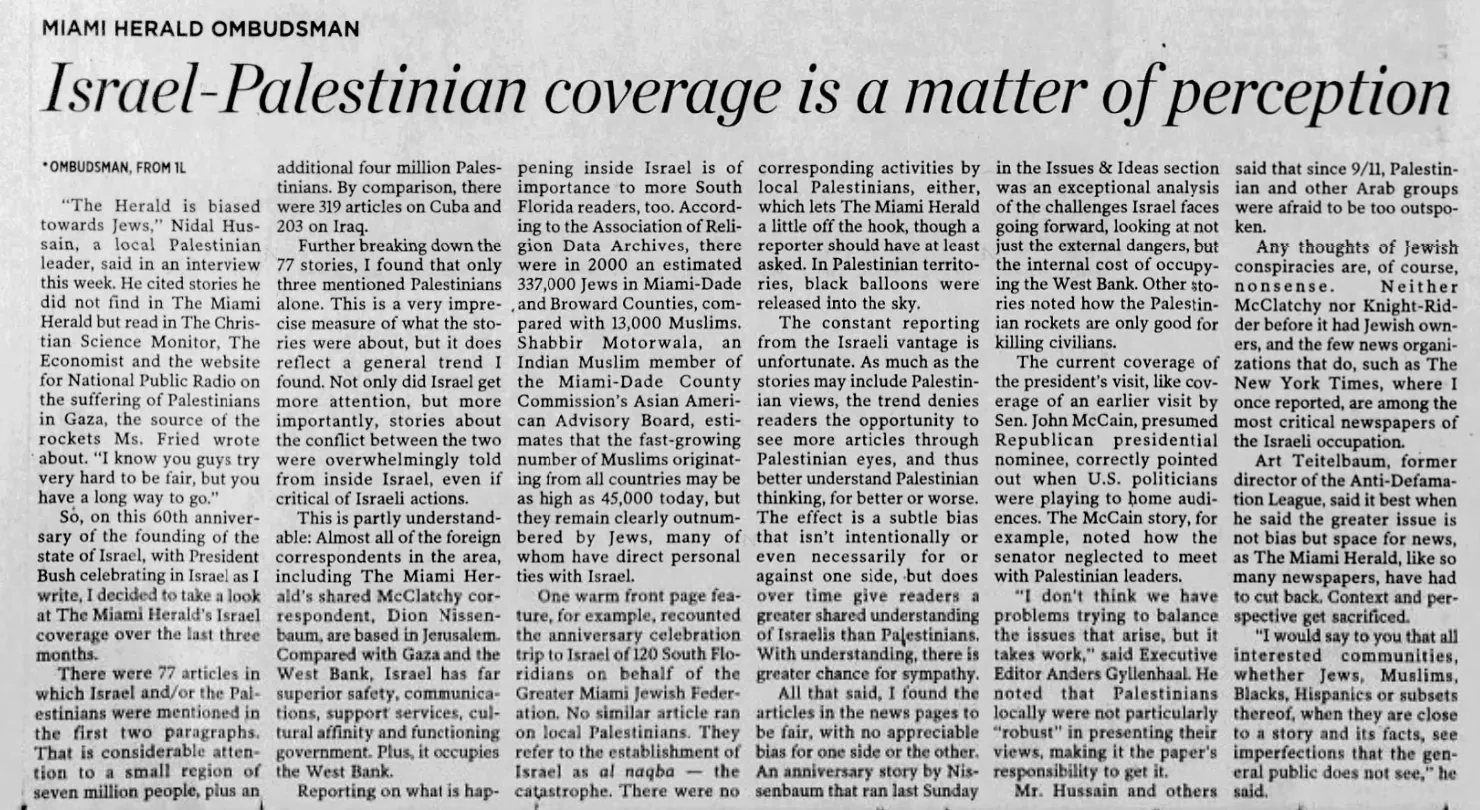
Transcribed from the clipping
“‘The Herald is biased towards Jews,’ Nidal Hussain, a local Palestinian leader, said in an interview this week. He cited stories he did not find in The Miami Herald but read in The Christian Science Monitor, The Economist and the website for National Public Radio on the suffering of Palestinians in Gaza, the source of the rockets Ms. Fried wrote about.
‘I know you guys try very hard to be fair, but you have a long way to go.’ So, on this 60th anniversary of the founding of the state of Israel, with President Bush celebrating in Israel as I write, I decided to take a look at The Miami Herald’s Israel coverage over the last three months.
There were 77 articles in which Israel and/or the Palestinians were mentioned in the first two paragraphs. That is considerable attention to a small region of seven million people, plus an additional four million Palestinians. By comparison, there were 319 articles on Cuba and 203 on Iraq.
Further breaking down the 77 stories, I found that only three mentioned Palestinians alone. This is a very imprecise measure of what the stories were about, but it does reflect a general trend I found.
Not only did Israel get more attention, but more importantly, stories about the conflict between the two were overwhelmingly told from inside Israel, even if critical of Israeli actions. This is partly understandable: Almost all of the foreign correspondents in the area, including The Miami Herald’s shared McClatchy correspondent, Dion Nissenbaum, are based in Jerusalem.
Compared with Gaza and the West Bank, Israel has far superior safety, communications, support services, cultural affinity and functioning government. Plus, it occupies the West Bank.
Reporting on what is happening inside Israel is of importance to more South Florida readers, too… One warm front page feature, for example, recounted the anniversary celebration trip to Israel of 120 South Floridians on behalf of the Greater Miami Jewish Federation. No similar article ran on local Palestinians.
They refer to the establishment of Israel as al naqba — the catastrophe. There were no corresponding activities by local Palestinians, either, which lets The Miami Herald a little off the hook, though a reporter should have at least asked. In Palestinian territories, black balloons were released into the sky.
The constant reporting from the Israeli vantage is unfortunate. As much as the stories may include Palestinian views, the trend denies readers the opportunity to see more articles through Palestinian eyes, and thus better understand Palestinian thinking, for better or worse.
The effect is a subtle bias that isn’t intentionally or even necessarily for or against one side, but does over time give readers a greater shared understanding of Israelis than Palestinians. With understanding, there is greater chance for sympathy.
All that said, I found the articles in the news pages to be fair, with no appreciable bias for one side or the other… ‘I don’t think we have problems trying to balance the issues that arise, but it takes work,’ said Executive Editor Anders Gyllenhaal.
He noted that Palestinians locally were not particularly ‘robust’ in presenting their views, making it the paper’s responsibility to get it. Mr. Hussain and others said that since 9/11, Palestinian and other Arab groups were afraid to be too outspoken. Any thoughts of Jewish conspiracies are, of course, nonsense.
Neither McClatchy nor Knight-Ridder before it had Jewish owners, and the few news organizations that do, such as The New York Times, where I once reported, are among the most critical newspapers of the Israeli occupation.
Art Teitelbaum, former director of the Anti-Defamation League, said it best when he said the greater issue is not bias but space for news, as The Miami Herald, like so many newspapers, have had to cut back. Context and perspective get sacrificed.
‘I would say to you that all interested communities, whether Jews, Muslims, Blacks, Hispanics or subsets thereof, when they are close to a story and its facts, see imperfections that the general public does not see,’ he said.”
Context added by this archive
A newspaper counting its own coverage: 77 articles in three months, only three about Palestinians alone, against 319 on Cuba. The ombudsman names the mechanism — correspondents based in Jerusalem, stories told from inside Israel — and calls the result a subtle bias that nobody intended.
Cite this clipping
"Israel-Palestinian coverage is a matter of perception," The Miami Herald, 18 May 2008, p. 1. Covering Palestine archive, CP-2008-003. https://coveringpalestine.org/archive/cp-2008-003
More from The Miami Herald
- Irgun Takes Arab City In Night BattleThe Miami Herald · 5 May 1948
- Arabs Learn ABCs With the Hatred Left OutThe Miami Herald · 7 September 1967
- Debate Rages on Arab Refugee ProblemThe Miami Herald · 7 October 1967
- Downing Airliner Also TerrorismThe Miami Herald · 14 March 1973
- Buildings Burn and Corpses Rot In What Remains of Tal ZaatarThe Miami Herald · 14 August 1976
- The PalestiniansThe Miami Herald · 29 May 1977
- 18 more from this paper in the full text →
More from the 2000s
- Food, not bombsColumbia Daily Tribune · 16 January 2008
- Gaza falls into darkness as fuel cut offCentre Daily Times · 21 January 2008
- Breakout from GazaGreat Falls Tribune · 24 January 2008
- Egypt works to restore borderChicago Tribune · 28 January 2008
- Punishing the people in Gaza feeds extremismDaily Herald · 4 February 2008
- Peace possible if both sides make commitmentThe News-Times · 1 March 2008
- All 516 clippings from the 2000s →
In these collections
Last updated 2 November 2026
This record is part of Covering Palestine, an archive of American newspaper clippings about Palestinians, 1724 to 2023. Researched and assembled by Maria Robles.
The clipping belongs to the newspaper that printed it, or to the news agency that supplied the copy. It is reproduced here for research, criticism and commentary. A city here is where the newspaper was published, not where the story came from, and on most records it was taken from the masthead.
Something wrong here, or something you know about this clipping? The archive is still being built and corrections are wanted: maria@rozumstudio.com, quoting CP-2008-003.
Everything printed in 2008 · Printed on this day · See it in the archive reel · Full text of every clipping · Dataset