The New York Times · 19 November 1979
CP-1979-033
The Palestinian Mission
By Edward W. Said
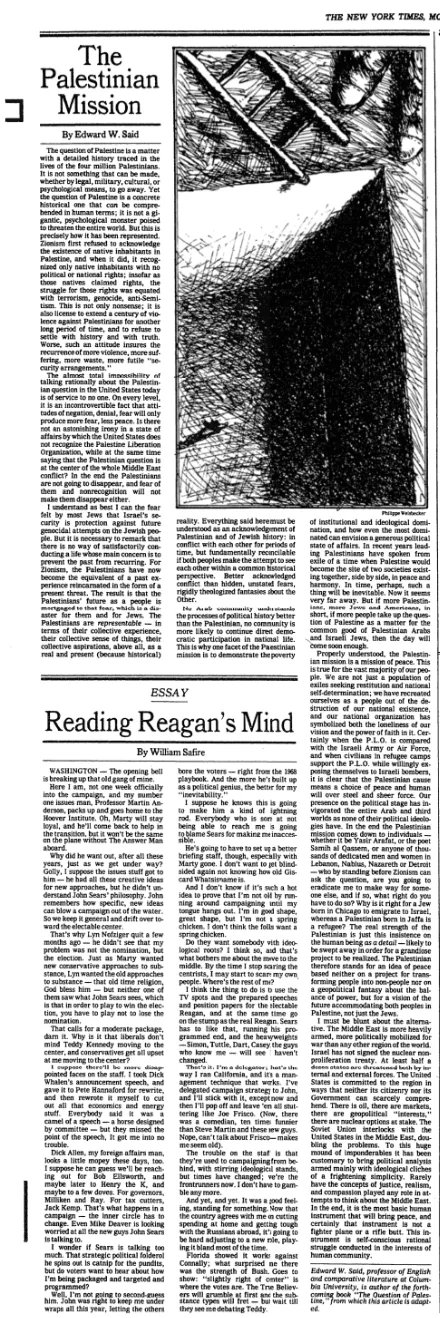
Transcribed from the clipping
The question of Palestine is a matter with a detailed history traced in the lives of the four million Palestinians. It is not something that can be made, whether by legal, military, cultural, or psychological means, to go away.
Yet the question of Palestine is a concrete historical one that can be comprehended in human terms; it is not a gigantic, psychological monster poised to threaten the entire world. But this is precisely how it has been represented.
Zionism first refused to acknowledge the existence of native inhabitants in Palestine, and when it did, it recognized only native inhabitants with no political or national rights; insofar as those natives claimed rights, the struggle for those rights was equated with terrorism, genocide, anti-Semitism.
This is not only nonsense; it is also license to extend a century of violence against Palestinians for another long period of time, and to refuse to settle with history and with truth. Worse, such an attitude insures the recurrence of more violence, more suffering, more waste, more futile “security arrangements.”
The almost total impossibility of talking rationally about the Palestinian question in the United States today is of service to no one. On every level, it is an incontrovertible fact that attitudes of negation, denial, fear will only produce more fear, less peace.
Is there not an astonishing irony in a state of affairs by which the United States does not recognize the Palestine Liberation Organization, while at the same time saying that the Palestinian question is at the center of the whole Middle East conflict?
In the end the Palestinians are not going to disappear, and fear of them and nonrecognition will not make them disappear either. I understand as best I can the fear felt by most Jews that Israel’s security is protection against future genocidal attempts on the Jewish people.
How this transcription was made
Read from the scan at 6x to 22x by a machine looking at the image of the page, not by OCR and not by a person. The folio prints 'THE NEW YORK TIMES, MO' and is then cut by the clipping edge; 19 November 1979 was a Monday, which the surviving fragment supports, and there is no dateline because this is an Op-Ed page essay. The companion image on the same slide is a known duplicate, so this record takes the remaining label date, with the folio fragment as corroboration. This is the only item in its deck block written BY a Palestinian rather than about Palestinians; Edward Said is a professor and a member of the Palestine National Council at this date and is not counted toward the archive's tally of named ordinary Palestinians. The excerpt is long because the essay's argument - that Zionism 'recognized only native inhabitants with no political or national rights' - speaks directly to the archive's question about who gets named.
Cite this clipping
"The Palestinian Mission," The New York Times, 19 November 1979. Covering Palestine archive, CP-1979-033. https://coveringpalestine.org/archive/cp-1979-033
More from The New York Times
- The Maine Colony in PalestineThe New York Times · 12 November 1866
- Jewish Colonization in PalestineThe New York Times · 9 December 1883
- Jewish State in Palestine OpposedThe New York Times · 9 July 1897
- ZIONIST CONGRESS IN BASELThe New York Times · 31 August 1897
- ROME FEARS THE ZIONISTSThe New York Times · 12 September 1897
- PROGRESS OF ZIONISMThe New York Times · 16 December 1901
- 852 more from this paper in the full text →
More from the 1970s
- Dayan warns Arabs in Israel and the territoriesThe New York Times · 24 January 1979
- SIX ARAB STUDENTS IN ISRAEL CONFINEDThe New York Times · 27 January 1979
- Are Israelis guilty of systematic torture? Perhaps, U.S. reports cautiously suggestHonolulu Advertiser · 7 February 1979
- Colony for U.S. Jews Is Approved by IsraelThe New York Times · 8 February 1979
- Israel Denies Torture of ArabsThe New York Times · 8 February 1979
- WritersDes Moines Register · 11 March 1979
- All 338 clippings from the 1970s →
Last updated 2 November 2026
This record is part of Covering Palestine, an archive of American newspaper clippings about Palestinians, 1724 to 2023. Researched and assembled by Maria Robles.
The clipping belongs to the newspaper that printed it, or to the news agency that supplied the copy. It is reproduced here for research, criticism and commentary. A city here is where the newspaper was published, not where the story came from, and on most records it was taken from the masthead.
Something wrong here, or something you know about this clipping? The archive is still being built and corrections are wanted: maria@rozumstudio.com, quoting CP-1979-033.
Everything printed in 1979 · Printed on this day · See it in the archive reel · Full text of every clipping · Dataset